Showing posts with label Brooklyn. Show all posts

Thursday, July 16, 2015

The Case for Graffiti Murals

As I noted in my last post, I visited Bilbao last month to take part in a conference about the creative industries. It was an phenomenal experience, but the hardest part was trying to distill the crux of my book, which goes on sale on August 28, into 5 to 7 minute presentation.

What really went over best was when I dropped in a slide that connected New York to the local neighborhood of Zorrotzaurre, which only worked because I got there a day early and was able to run to the area and take pictures. You'll also note that it's tailored for the conference, and when I deliver it again, I'll make lots of changes to reflect a new audience.

Anyway, hope y'all like it. Enjoy!

New York City Graffiti Murals

In 1975, New York City was the kind of place where the city’s police and fire unions created this “survival guide.”
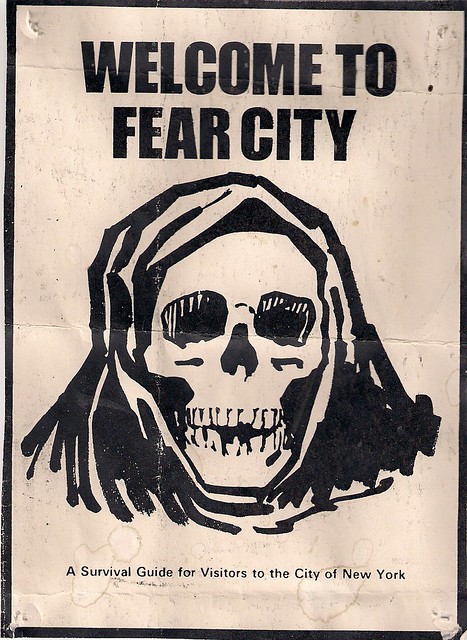
Fear City


They were trying to prevent layoffs at the time, and one of their strategies was to promote the fear that the city was completely out of control. Unsurprisingly, the reaction to it was so negative, it was never actually distributed, but it tells you a lot about the way things were back then.

Fast forward 40 years, and you’ll find a very different New York City from that one. The crime that was rampant back then has receded, and real estate prices have sky-rocketed. A penthouse in the One57 tower on Central Park, for instance, sold for $100 million in January.
05-003

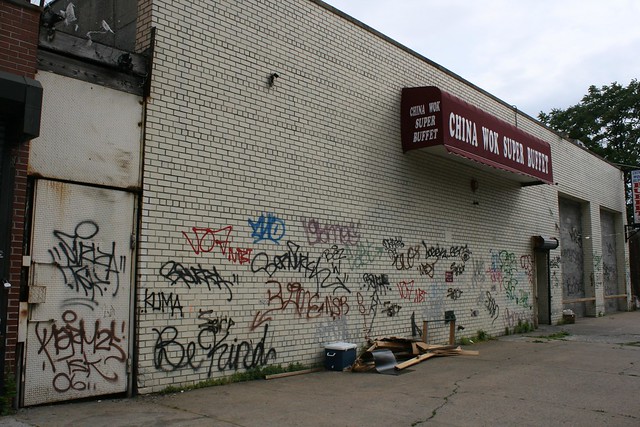
Graffiti, which also first appeared in the 1970’s, is still present though. It’s no longer the scourge of the subways that it once was, but it is still present, particularly outside of Manhattan. Mind you, it’s very much illegal, and the punishments are quite harsh: A felony charge awaits adults caught doing it, and stores are actually prohibited from displaying real cans of spray paint in their window, lest they tempt teenagers to steal them. Unlike in some European cities, there are no areas of the city where it is legal to do graffiti, so if you want to do it without breaking the law, you have to partner with a building owner.

But despite graffiti’s association with crime, it is very much a part of the cultural fabric of New York City, and in the right context, it can empower local communities and enliven streetscapes that are simply being scrubbed blank today.

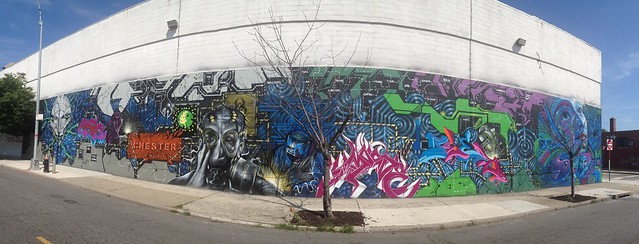
I’m talking about this sort of thing:
17-005

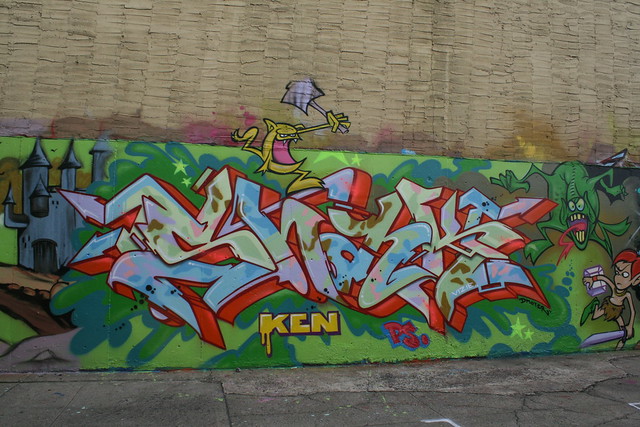
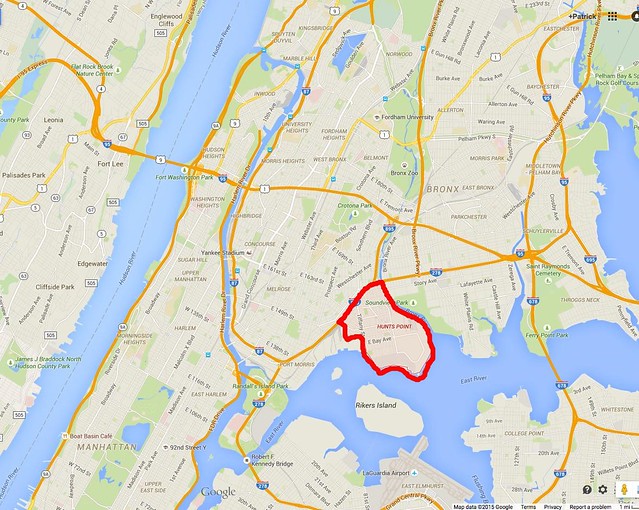
This is a mural in the central Brooklyn neighborhood of Gowanus that was done with the building owners’ permission. For my thesis, I visited six locations around the New York City metropolitan area to learn how these kinds of murals are created, and the effects they have on the area. Today I’m going to focus on one of those locations, Hunts’ Point in the Bronx.
Hunts Point
The Bronx is the poorest of the five boroughs, or counties, in New York City, and Hunt’s Point is one of the poorest parts of the borough. But it’s also the site of amazing graffiti, thanks to the TATS Cru, a group of graffiti artists who have created a business out of graffiti. In Hunts Point, they do murals like this:
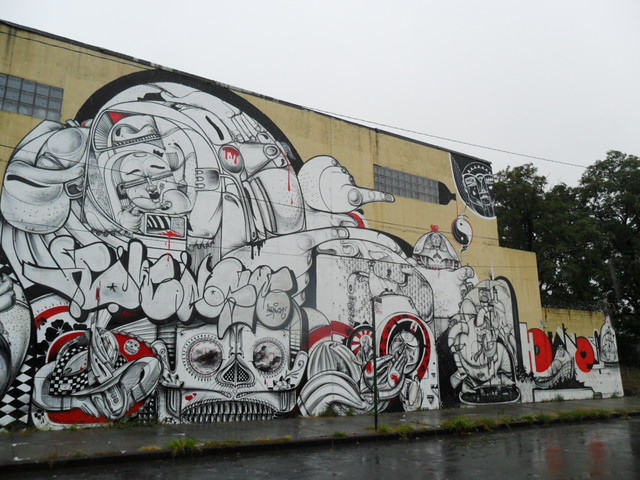
SAM_0315 And this
IMG_3015
The TATS Cru’s work in the Bronx is relevant to a conference about Cultural and Creative Industries, because the group members are from the area, and rather than displace the poor, they use the tools of an art form that was invented on the streets, and is extremely democratic. One need only secure a wall and spray paint to bring color to the masses. And that’s what Hector Rodriguez, one of the founders of the TATs Cru, told me when I interviewed him. I quote:

“Not everyone in New York City really has the time to partake in the art culture that’s out there. The stuff that we’re putting out there in these neighborhoods, is the modern day Picassos, Goyas and Monets that bring art and color to other people’s lives. They don’t have any other color in their life, outside of what we’re painting out there.”

Just up the road from Hunt’s Point is another mural that the TATS Cru did that I’d like to share with you.
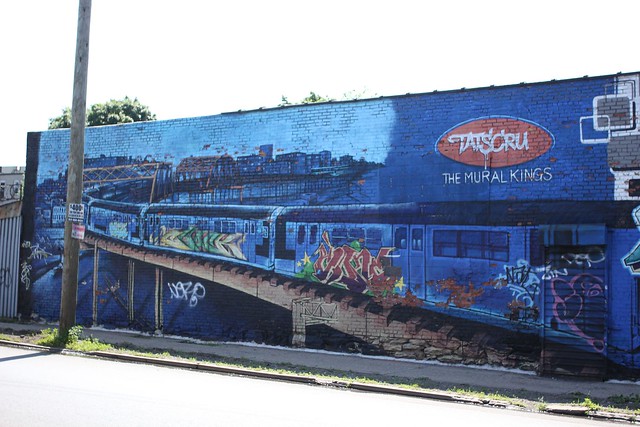
10-006
There are murals like this all over New York City, and they serve a very important function: They preserve local culture and tell residents that their community has value beyond mere real estate values. They are, in the words of Marxist scholar David Harvey, “Marks of Distinction,” which he says represent and I quote, “the collective symbolic capital that a city has accumulated through authenticity, uniqueness, and particular non-replicable qualities.”

Graffiti is a global art form today, but it was born on the streets of New York in the 1960’s and 70’s. It distinguishes New York from other places more than the One57 residential tower that I mentioned earlier, which are simply cogs in the transfer of capital from one global city to another.

I’ll take this over towers like that any day.
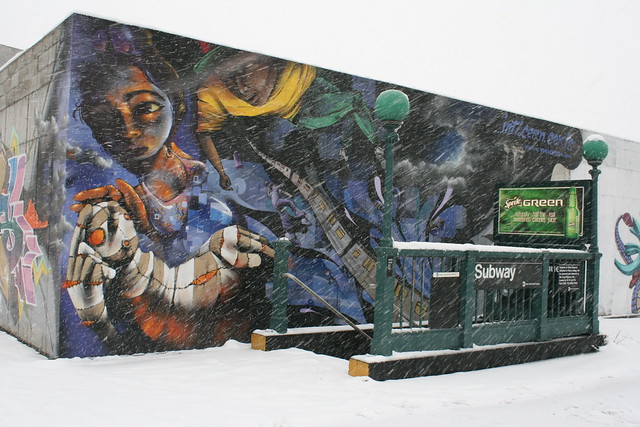
IMG_1769
Because many New Yorkers still associate graffiti with life in 1975, when 1,645 people were murdered there, it’s easy to understand why city government is hesitant to partner with graffiti artists. For comparison, there were a record low 328 murders last year.

It’s an example of “symbolic interactionism” a theory which states that people interact with each other by interpreting or defining each other’s actions instead of merely reacting to each other's actions. They don’t hate graffiti because of what it is. They hate it because of what it represents, which is a loss of control over space.

New York City currently reclaims that space for building owners for free, by erasing, or “buffing” graffiti, under a program over seen by the Economic Development Corporation. This helps owners regain control of their space, but I would argue that because the city government does not also promote partnerships building owners with artists who might want to create graffiti murals, it is missing out on an opportunity to promote a homegrown creative industry.
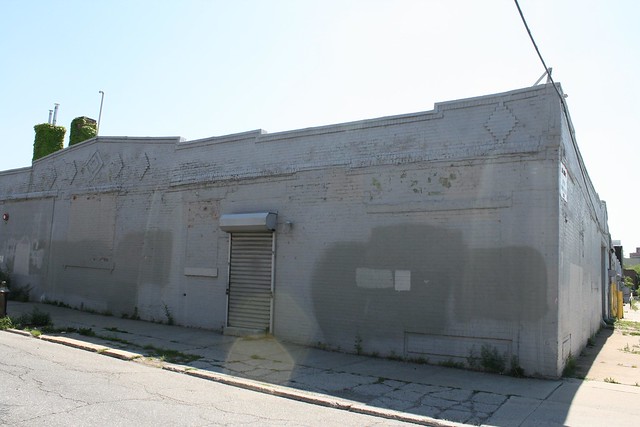
17-001
Although graffiti murals are primarily found in gentrifying neighborhoods that are popular with artists, such as Bushwick in northern Brooklyn, they can also be found in “uncool” areas like Staten Island, Trenton, New Jersey, and Hunt’s Point. And industrial neighborhoods have always been ripe for murals; I couldn’t help but be amazed at the amount of art in Zorrozaurre. IMG_4274 Regardless of where they are, they have the power to make a junkyard in Hunts Point into an art gallery.
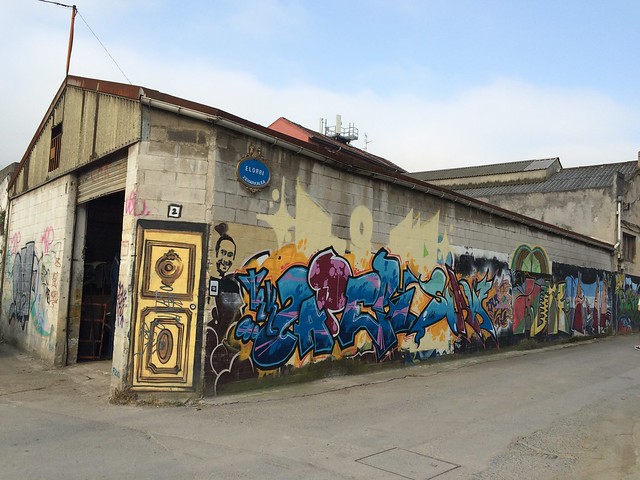
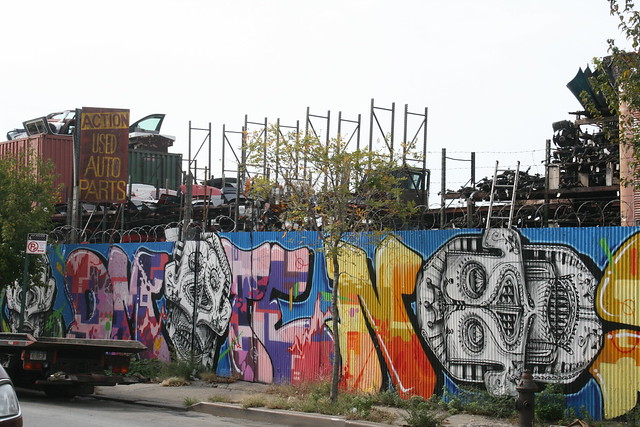
IMG_3018
In some cases, building owners hope that murals will help spur gentrification, but many simply desire a space that’s more aesthetically pleasing than graffiti tags. And while most would agree that a wall that’s been buffed clean is better than a wall that looks like this:
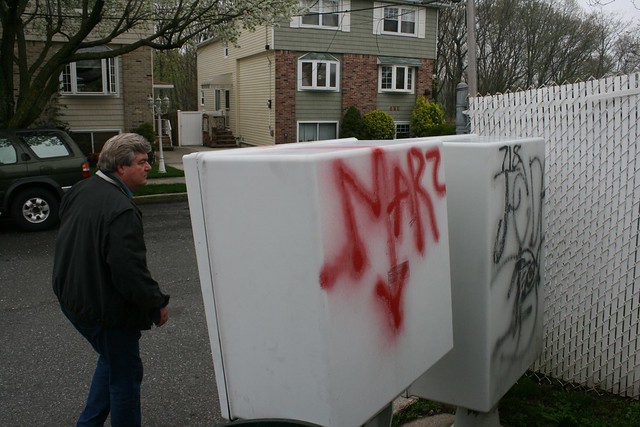
IMG_4136
My task has been to show how graffiti murals are better than both. The partnerships that currently exist between owners and artists who create murals are significantly better both for them and members of the community, who I also spoke to during my site visits. In Brooklyn, a building owner compared murals to growing a garden in an alley, while a resident of Jersey City said to me, and I quote:

“Tagging is usually done out of vengeance. You know, you’re mad at someone, you’re mad at the person in the building and you just want to tag something, just to let them know that you was here, and you really don’t care if it’s painted over or if it’s clean, you know, when the bricks are clean. But when you do a mural like this, you’re really putting your heart into it. So it’s totally different.”
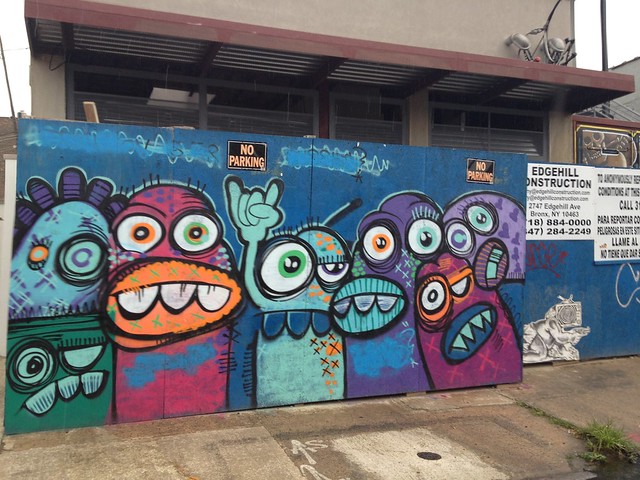
IMG_2001
Finally, there’s the issue of authenticity. In 1939, Walter Benjamin wrote, and I quote, “the uniqueness of the work of art is identical to its embedded-ness in the context of tradition. This tradition itself is thoroughly alive and extremely changeable. What was equally evident to both was its uniqueness, its aura.”

Graffiti murals are derived from the tags that first appeared on the streets and subways of New York. Their aura is on the street, and it’s partly because of this authenticity that people from around the world flock to see the graffiti and street art of New York.

In conclusion, I am optimistic that the people in New York are beginning to understand the value of graffiti murals. The six owners I spoke to for my thesis are great examples of private property owners who prefer art over blank spaces, and there are two other groups that are leading the charge to beautify the city: The city’s department of transportation, and Groundswell, a non profit group.
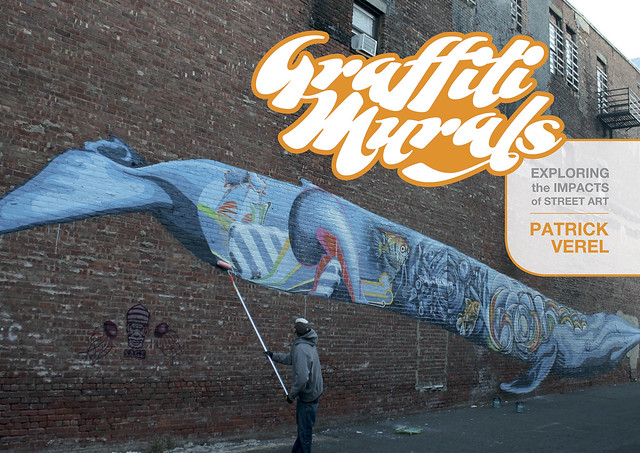
Graffiti Mural Book Cover
If you’d like to learn more, my thesis is being published in August as a book; I’d be happy to share more info with you on how to buy a copy.

Thank you.

Wednesday, January 14, 2015

On Broken Windows and Quality of Life Crime

"Broken Windows" is really enjoying a renaissance, isn't it? I mean, I'm no criminologist, but it's fascinating to see how a grand theory about fighting crime has held such an iron-clad grip on the hearts and minds of leaders for two decades, even as the level and severity of crime has dropped in jaw dropping fashion.

Even Bill DeBlasio, an unrepentant liberal mayor the likes of which New York hasn't seen since the days of dial up modems and flannel shirts, has embraced the notion that you can stop major crimes before they happen by unleashing the wrath of the state on anyone who jumps a turnstyle, drinks in public or tags a building.

He showed his support for it by hiring Bill Bratton to be his police commissioner, and he's stood by it even in the aftermath of Eric Garner's death in Staten Island. Garner was confronted by the police for selling "loosie" cigarettes, the exact kind of "quality of life" crime that falls under the Broken Windows purview. Hizzoner has made notable exceptions when it comes to marijuana and "Stop & Frisk," but otherwise, the message has remained the same: Order = Prosperity, therefore Order must be upheld.
When Yoshi starts showing up around town,
you know all hell is breaking loose.

Except, maybe sometimes not? As has been documented voluminously, members of the NYPD have followed the lead of their reprehensible union leaders and all but rebelled against the city, first with disrespectful displays directed at the mayor, and then in a brief slowdown. One astute commenter noted at the time, this latter action could result in two possibilities:

1) There is a corresponding spike in crime, in which case the NYPD has purposefully put us all at risk to make a stupid political point.

2) There is no corresponding spike in crime, which means "Broken Windows" is a failed strategy and the NYPD's aggressiveness was never necessary.

Now, I have zero tolerance for grown men who spout cartoonish gibberish like "The mayor literally has blood on his hands," and even this guy, who starts out reasonably well, loses me when he slags "anti-police protesters." Um, Steve? They're anti-bad police protesters, not anti all police, ok?

Delores Jones-Brown, a criminologist at John Jay, nailed it recently when she said, somewhat inarticulately, “There is a way in which whether to say anything against the existing policing regime, it gets interpreted as anti-police.”

And eye for an eye, and we'll all go blind.
But while Steve Osborne and his ilk may be blinded by their seething hatred of Al Sharpton, I wholeheartedly support this latter thought, which I feel obliged to print in full:

Most cops I know feel tired of being pushed to do more and more, and then even more. More police productivity has meant far less crime, but at a certain point New York began to feel like, yes, a police state, and the police don’t like it any more than you do. Tremendous successes were achieved in battling crime and making this city a much better place to live and work in and visit. But the time has probably come for the Police Department to ease up on the low-level “broken-windows” stuff while re-evaluating the impact it may or may not have on real, serious crime. No one will welcome this more than the average cop on the beat, who has been pressed to find crime where so much less of it exists.

Makes sense, right? If I were a cop, I'd be annoyed as fuck that I had to spend my time harassing people for minor offenses while simultaneously blamed for inflaming tensions. especially when the city just recorded yet another record low of homicides (328! compared to 2,245 in 1990). People smarter than me have been questioning its effectiveness since 2001 (side note: Dreadful day to have published this op-ed, amiright?) Clearly, something has to change.
The hellhole that is Williamsburg
 The city's never ending war on graffiti is one head in the Broken Windows hydra, so if there is any serious reckoning with the policy, I hope it's would be part of any review. This isn't to say I'm in favor of letting vandals trash residential houses, render signage unusable, and wreck public parks. I'm thinking something more along the lines of asking, why is it that Greenpoint, Williamsburg and Bushwick, arguably the three most graffiti-filled neighborhoods in Brooklyn, are also at the heart of the "Manhattanization of Brooklyn?"

If graffiti is such a gateway to crime, what the hell are all these rich people doing there? Might some of that vandal squad energy be better served somewhere else?

Speaking of which, "Graffiti Murals: Examining the Impact of Street Art" will hit the streets in August. Be sure to reserve your advance copy here.

Happy New Years y'all!

Saturday, January 11, 2014

How to spot a vandal

When I was in college working at WSJU as the metal director, I received a CD from a metal band whose name on the cover was simply A.C.  The abbreviation referred not to Air Conditioning, but rather, "Anal Cunt." Nice, right? Sorry, probably should have warned you that was coming.

Naturally, one might wonder, 'Why would someone give their band a name that no one would EVER want to say out loud?' Why not call yourself "The Turds?" (Again, sorry)

I thought about this band last night when I saw on Instagram some of the reactions to the defacement of Swoon and Groundswell's magnificent mural on Houston and the Bowery. I spend a lot of time thinking about what differentiates street art and graffiti from simple vandalism, and while this is a very clear cut example of the latter, that's not what puzzles me in this particular instance.
The mural after it had been bombed
Rather, what intrigues me is the mindset of a vandal versus the mindset of an artist. I think the difference is that an artist does things for others, whereas a vandal does things only for themselves. The asshats who puked up sloppy looking throw-ups onto this mural aren't interested in engaging with anyone other than their own miniature clique, just as the fellas in A.C. weren't ever really interested in getting major air play on the radio.

Now to be fair, the A.C. guys weren't destroying someone elses' work (Ok, maybe someone's ears). [rimshot] But they were asserting by virtue of their name that they were perfectly happy to confine themselves to a subset of listeners whose sensibilities were unscathed by a most foul word pairing. They made music for themselves and those few folks, at least until 2011, when they apparently broke up.

Swoon's mural, which was a collaboration with Groundswell, was obviously targeted because it's a  high visibility location, and while the city was busy coping with a monster snow storm (which was then overshadowed by the Polar Vortex), the time was ripe to strike. Not only is it on a well-traveled street in Manhattan, it's illuminated by spotlights! So I get it. Who wouldn't want to stand in center stage?

There's no question the jerkoffs who did this did it to ruin it. There's nothing special or unique in their writing, and nothing about the placement of the throw ups suggests they cared a whit about what they were covering up. This was not an augmentation; they may as well have splashed buckets of acid onto it. So if the goal was simply to "get up," and appeal to their little clique, why not do it some other high visibility spot that wouldn't simultaneously wreck a piece of art for everyone? It's distressing to see that someone is so insecure in their own talents that they feel they have to destroy someone elses' work in order to get satisfaction.

On the flip side, as one commenter noted, "Illegal graff is how it started, lest we not forget. Swoon is a great talent, but the street has no heart and plays by no rule book." There is a nugget of truth here; part of what makes New Yorkers tough as nails is the fact that we're constantly trying to tear each other down, like something out of that Brad Pitt zombie movie:


When you put something out in the public, you take a huge risk that misanthropes will crawl out of the sewer and rip it to shreds, and street artists know this more than anyone. I suspect that's part of the reason why some of the best pieces I've ever seen have been in out of the way spots, safe from the likes of hacks.

Unfortunately, this also illustrates the one caveat to my thesis, which says that murals can be a deterrent to vandalism because there's a certain"honor among thieves," that writers adhere to when choosing where to do their graffiti. Where that seems to fall apart is when the writers don't care for the muralist (in this case Swoon is not strictly known as a graffiti artist, as she does a lot of paste-ups), when a location is just too good to pass up on, or when people just feel like being dicks. In this particular case, we got the whole trifecta.

Fortunately, there still are those out of the way spots where art can survive relatively unscathed. As chance would have it, I discovered another Swoon this past weekend during a run through a remote part of Red Hook.
A woman driving a mini van actually passed by me while I was taking this, stopped 20 or so feet away, and then backed up to see it. Not too surprising why. 

I also stumbled on this:


And this:


And finally, I feel what is most appropriate, considering the topic of vandalism:
I know, it's probably too much to ask the folks who went after the Bowery mural to devote more energies toward augmenting more ruins like this and less time destroying other's works. If only they could take a cue from the gentlemen in A.C. and simply stick to impressing their own little band of outsiders. Alas...

Friday, September 13, 2013

The Pitch


Hey, ya like this? When I was a kid, we used to say stuff like this was "ill". Do kids still say that sort of thing? I have no idea, but I think we should bring back the term, if for no other reason that we could maybe hear You Be Illin' on the radio again. Ah well, one can always dream...

Speaking of dreaming, the truly hard work has commenced as far as the thesis is concerned. It's done, but at the moment, it's still just a PDF sitting on the hard drives of myself, a few friends, family, and Fordham (who will eventually make it available here). What good is that though?

So I've begun poking around looking for someone to publish this thing. One of the first problems I ran into was that many journals have word count limits. Public Art Dialogue, which was suggested to me by the fellow who runs Vandalog, for instance, has an 8,000 word limit for submissions to theirs. When I did a word count on my opus, I came out with 41,186 words. Yowza!

Now, granted, this includes appendixes, the bibliography and a whole chapter on 5 Pointz that can easily be cut, as it's more or less bonus material. But still. How the HELL does one cut that down to 8,000 words? Forget cutting to the bone; that feels like I'd be cutting it down to a shadow.

Then there's the issue of who would want to publish such a thing? It's a scholarly piece of writing, but not in the strictest sense, as I've been told my tone is much more colloquial than what is expected for peer-reviewed journals. But also it's not really the kind of work you see in popular publishing either, as it's not a picture book. Well, it does have nearly 80 pictures, so that helps!

Since this is all so new to me, I've been reaching out to as many people as I can think of who might know someone who knows someone who might be willing to have a peek at my work. If I can whittle it down to a fifth of what it currently is, I will submit it to Public Art Dialogue. At the suggestion of Eric Felisbret at @149th St, I e-mailed four publishers; two never responded, and one said they really only do visual books. But another actually responded Wednesday (I'm not going to name them, lest I jinx myself) and asked me to submit, as part of a formal proposal:

-Table of Contents or outline
-A proposed introduction
-A few pages of text
-Six or so sample illustrations

Woo!

Oh wait, I feel the need for a break here.
Holla!
So yeah, it's very exciting. Also, predictably scary. I've been writing professionally for 15 years, but this is the first time I've put forth something this big. Given how many terrific books there are about graffiti and street art, it's easy to wonder where my work fits in the existing canon.

I've cut and pasted the Brooklyn chapter, the intro and a slightly pruned down table of contents into a proposal, and will throw in a few images from that case study, and tweak it all so it all seems to go together seemlessly. Then it's back to the old "What do you think of this?" query to a few trusted sources to see if it makes any sense.

Then, who knows? Maybe a book? Stay tuned.

Oh, and for what it's worth, the preceding images are courtesy of the Bushwick Collective and nearby surroundings. Do check them out. It's jaw droppingly good out there.

P.S. If you'd actually like to read the thesis, drop me a line at pverel(at)yahoo.com. I'd be happy to send you a copy.

Thursday, August 15, 2013

The Geisha returns

When it comes to street art and graffiti, the Boerum Hill/Carroll Gardens/Cobble Hill area of Brooklyn has nothing on places like Williamsburg, Bushwick, Bed/Stuy, Dumbo or Long Island City. It's hip here, but not that hip, and in any case, brownstones don't make for the best canvasses.

But we do have enough of a scene to keep things interesting, if you pay close attention. A lot of what we have is pretty amateurish, and even the Zemo (thanks to my wife Kelly for casting the sole vote in my poll to determine his tag) is often seen as more of a work in progress, every so often, someone comes along who clearly has chops.

Back in May, we were graced with paste ups of "boom box Geisha."

On a phone booth
On the side of a building
On the side of an abandoned kiosk

On a mail box

On another mailbox

On a construction fence


They varied a bit, but you get the gist. Not bad, right? Kind of a nice addition to the tags. I prefer the red one on the green box. Being paste ups, they didn't last long, of course; I'd say by late June, most were gone.

But the Geishas have not left  for good. They returned last month, just as we were embarking on a pilgrimage to Martha's Vineyard for some much needed beach time. On July 18th, I walked out to get some bagels for the long ride, and found this at the entrance to my subway:


Yup, the Geisha is back, and she brought a friend. A rainbow tooth? A Pac-Man ghost? Not really sure what that little guy is, but he seems to go with this variation of the Geisha. Again, she's now ensconced all up and down Smith Street:
By the bagel joint (alas, this construction fence has been removed)
On another construction fence

Here tooth guy accompanies two of the Geishas with boomboxes on another one of the abandoned kiosks. Bonus view of ZEMO.

On the door of the Met Supermarket
Grateful that these whimsical characters have resurfaced in the hood, and intrigued to learn who might be behind them, I turned last night to Flickr and did a quick search for the words "boombox" and "geisha," and bingo; I found Geisha Boombox by Jonathan Wakuda Fischer. Seems Fischer is in town from Seattle for a job, and from the looks of his blog, he's quite the street art fan. Interestingly, you can also find these pieces on display in some very reputable places.

His second round on Smith Street has also yielded a definitively positive response from the locals, if this recent buff is any indication. Gone are the tags from Trooz and Merdz (whose work was, lets face it, pretty lacking), as well as the rainbow tooth. But the Geisha remains, alone in amidst a dark red sea, for who knows how long.
So cheers Jonathan! Thanks for visiting the neighborhood!

Thursday, June 27, 2013

And then there's this guy...

So now that we've visited the highest profile graffiti locale in NYC (Brooklyn Street Art just called 5 Pointz a "graffiti holy place" yesterday), I thought it would be fun to come back down to more low key, under the radar phenomenon.

Whereas the artists who write at 5 Pointz are in many cases internationally known, this guy or gal seems, so far as I can tell, is limited to a very small section of Brooklyn. Namely, mine. Ladies and gentlemen, I give you, um....well, I have no idea what to call this dude. Z-Dog?
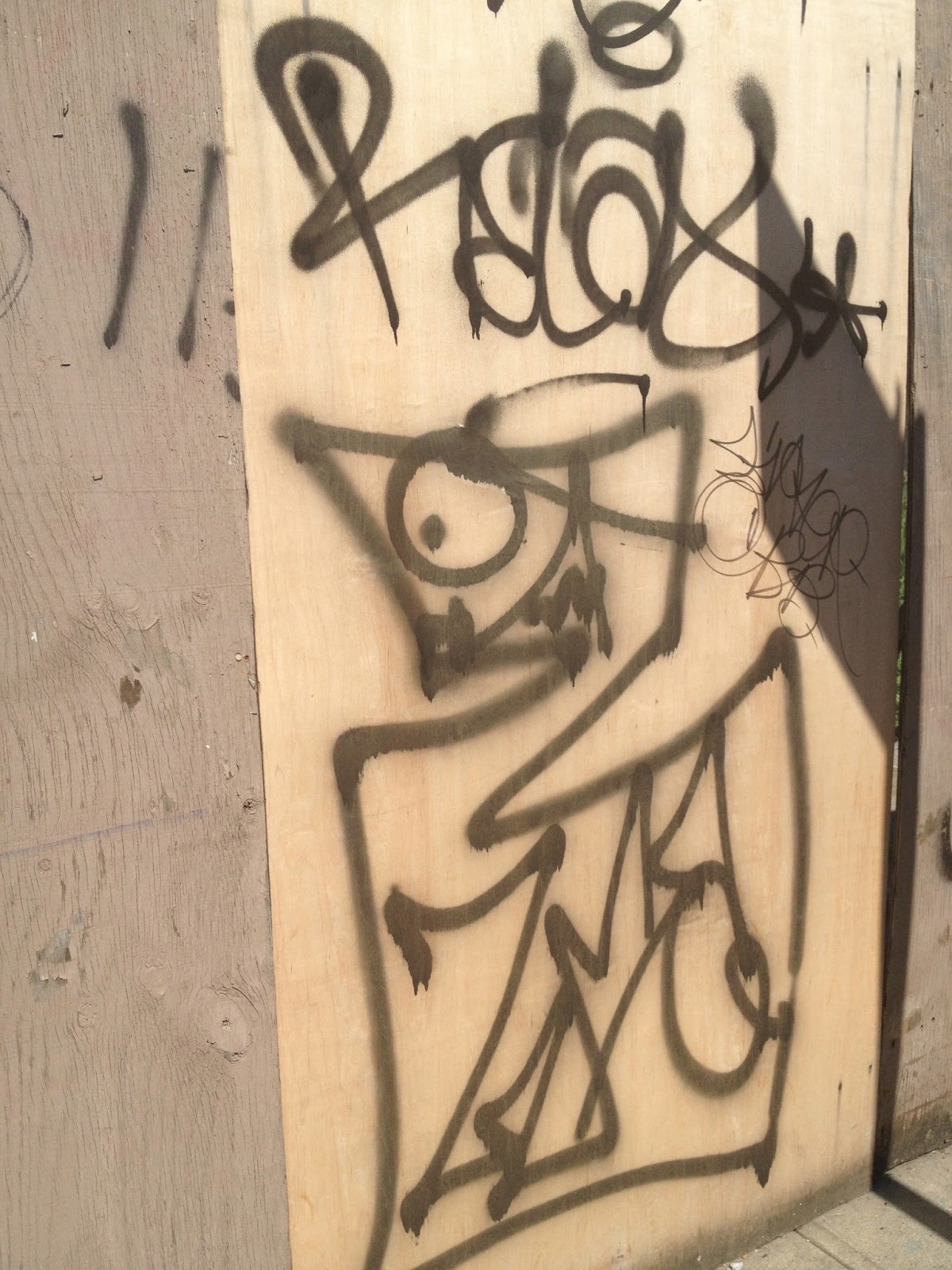
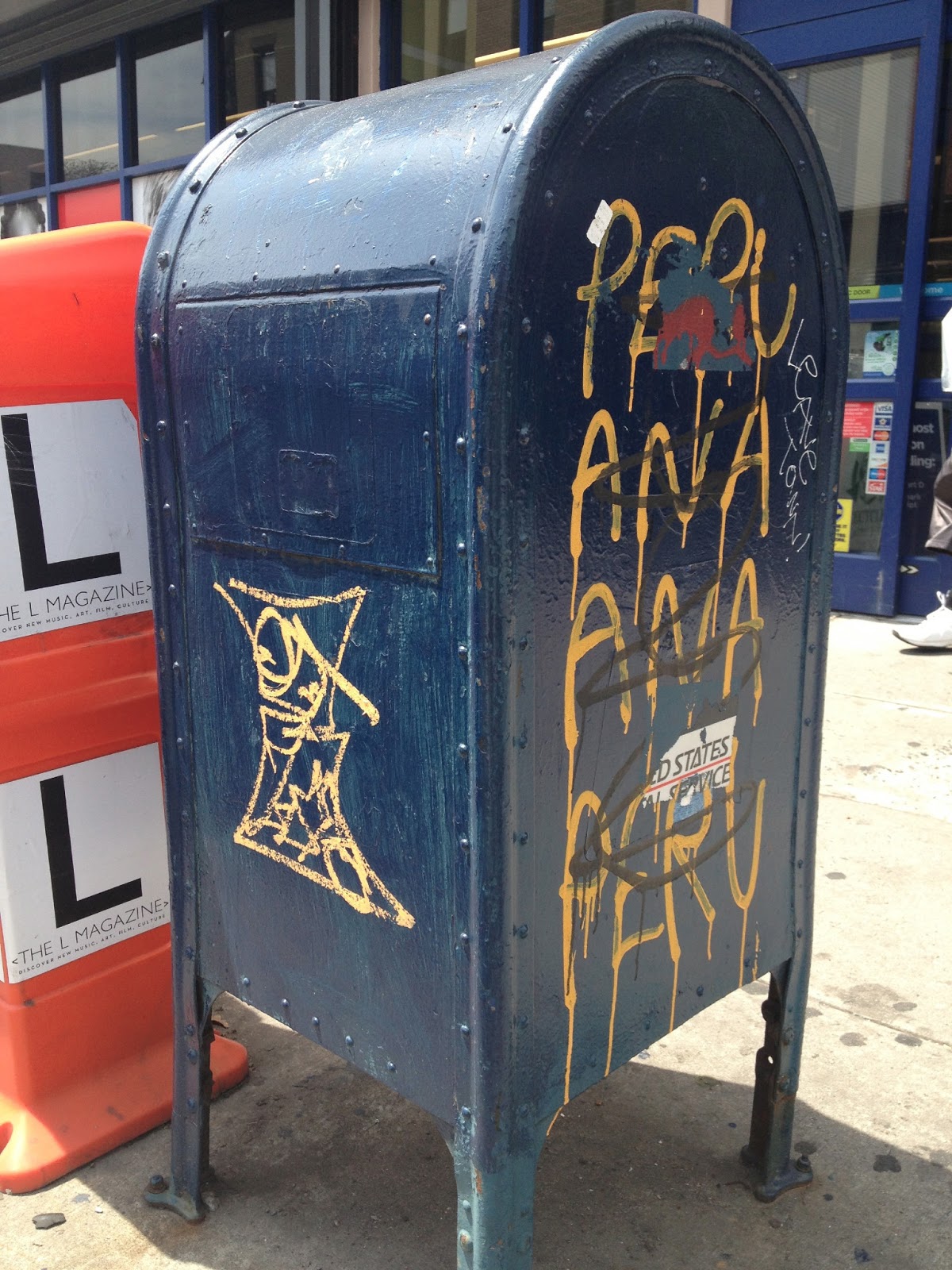
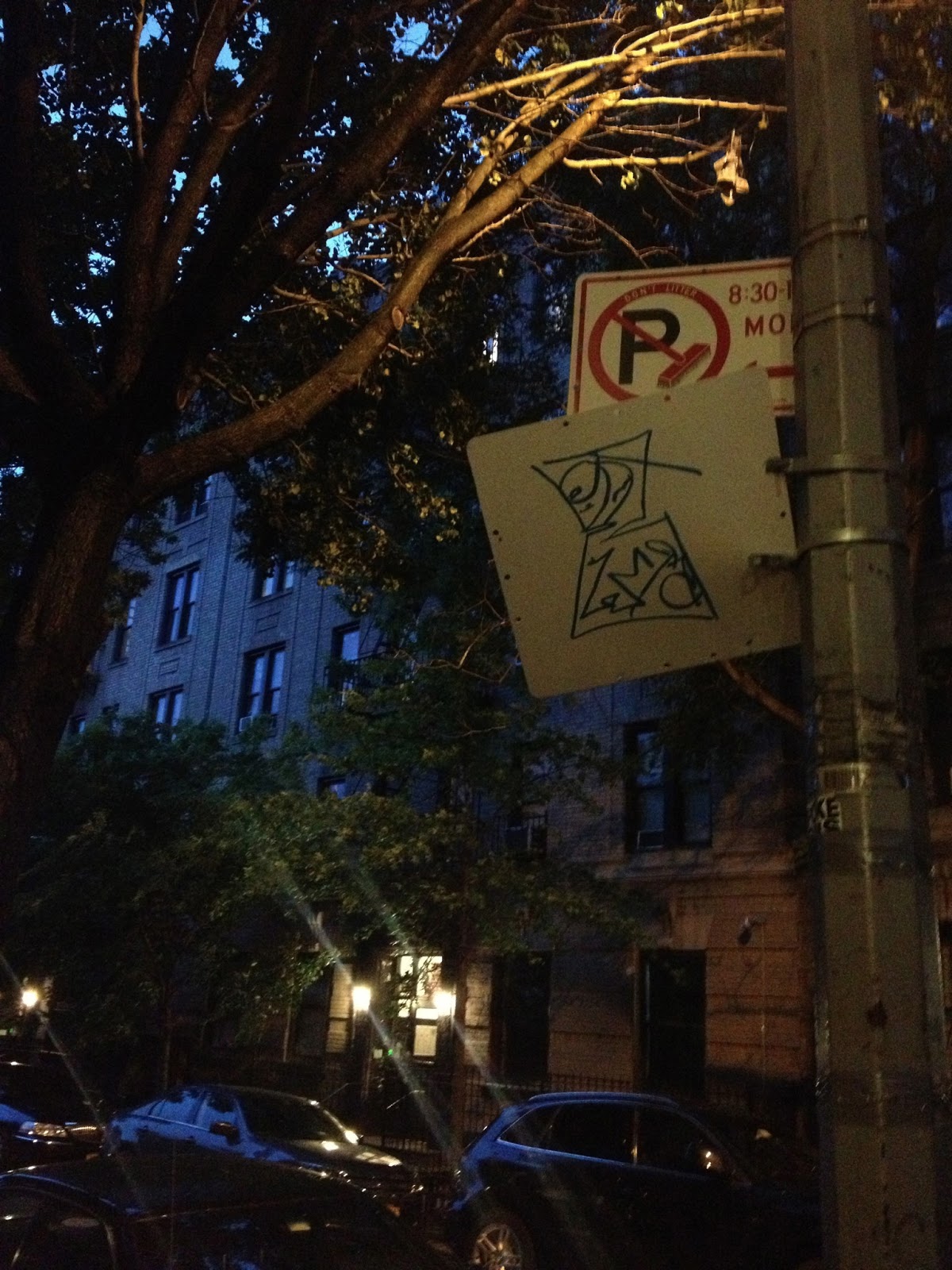
This was taken on the side of a construction fence along Smith Street, which is the major commercial thoroughfare that runs between the neighborhoods of Cobble Hill, Carroll Gardens and Boerum Hill. The F and G trains rumble along underneath it, and on street level, it's chock full of boutiques, restaurants and bars. It's one of something like 35 versions of the same tag, which is always in the shape of a Z, (or maybe a 2?) and usually adorned with an eye, a mouth and some script inside.

Doors are a popular target
It's is a relatively new tag in the neighborhood, and it got my attention because like UFO, EKG and Jellyfish, it's obviously meant to be more graphical than textual. It's also fairly compact, which you can see compared to the purple tag above. It can be found along Smith Street, Court Street, and some of the side streets, as far up as Atlantic Avenue, and as far south as 9th Street. Basically, the three neighborhoods sometimes known by the horrible portmanteau BOCOCA, plus a few in Gowanus for good measure.

Mail boxes are also a popular canvas.
Unlike those three, however, this has letter scheme attached to it, and for the life of me, I have no idea what it says. I even asked Luna Park, who along with Becky Fuller, runs the site The Street Spot, if she knew what it said, and it was news to her too. Also unlike those three, whoever does this Z shaped tag is clearly experimenting along the way:
Look, I have a tail!
I'm duo tone!

And sometimes it's pretty obvious that he got spooked before he was able to finish.


If I had to guess, I'd say this is a kid from the neighborhood who is trying out his hand on something that is meant to stand out among the other tags in the neighborhood. And while I'm not terribly impressed with the script inside the outline, I'll admit I'm a sucker for a cute character, especially one who pops up in so many different places as I go for walks, pick up groceries or do whatever else it is I need to do outside of the confines of my apartment. It's also a reminder that one does not necessarily need a large space to make a mark.


So what do you think this guys' tag says? Thoughts? If you've just GOT to have more of this, there's lots more where that came from here.