Showing posts with label Queens. Show all posts

Tuesday, September 16, 2014

Rollin, Rollin, Rollin...

Several months ago, I stumbled across an online map that had been created by a popular energy drink concern that I'd rather not name. The map detailed in fairly impressive fashion, the locations of the most popular street art in New York City.

It rubbed me the wrong way for the same reason that apps that do the same thing do. When I first started seeking out graffiti, it didn't take me long to figure out on my own where to find the best stuff. Basically, my method was to go to industrial areas and just wander. And although I probably spent more time in the company of grime, filth and noise than I needed to, the thrill of the find always made it worth the shlep.

Not only does a map take away any sense of surprise, it also lays bare the one real downside of building-based murals: Lack of movement. Many of the the earliest graffiti masterpieces (I make no distinction between graffiti and street art) unmappable in the traditional sense, because they never actually stood still. They were on train cars, which meant you might be able to clue someone in to the existence of one by telling them what line it was running on, but that's it.

As we all know, the days of art-covered trains in NYC are long past. You might find a train that's been defaced by one of those dreadful car ads, but that's about it. Fortunately, we seem to be living in a renaissance of a different sort of movable art:

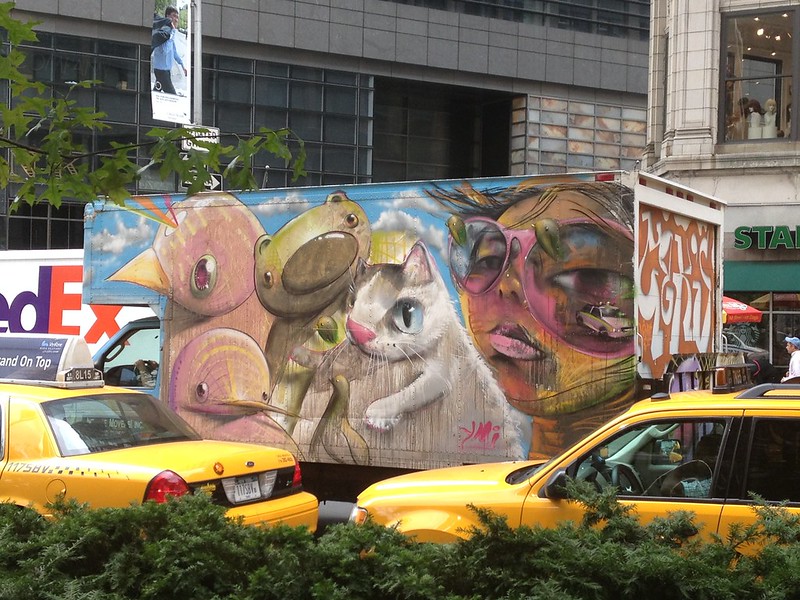
IMG_0747
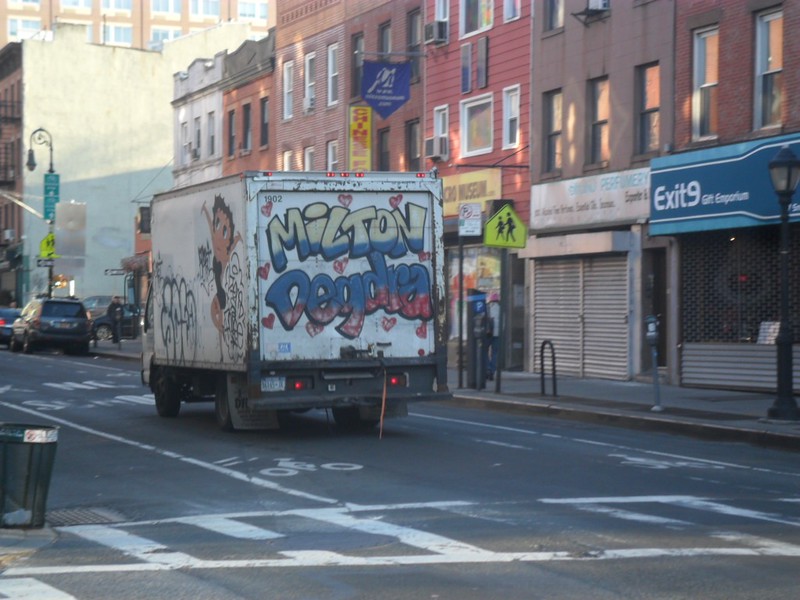
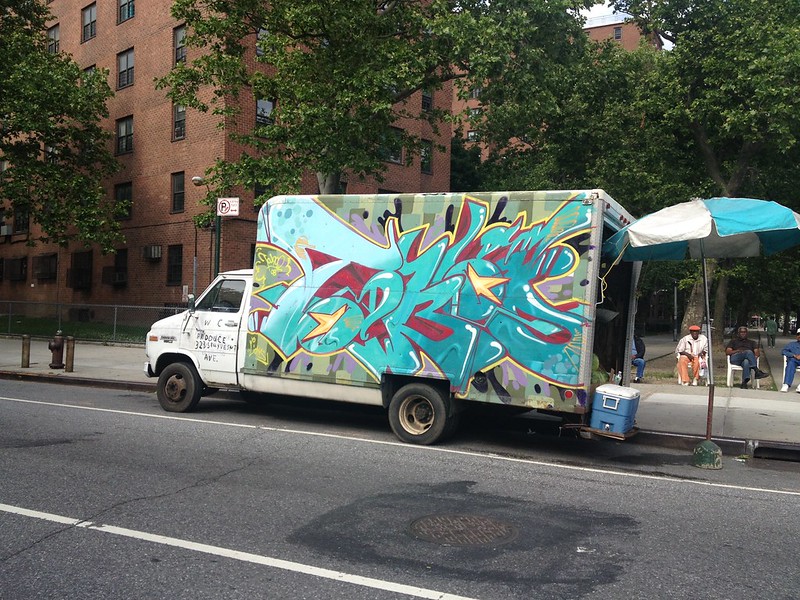
I think what I like best about the box truck (and occasional moving van) phenomenon is it brings the art to me. I rarely find myself able to get out to Bushwick, Williamsburg or the Bronx, but I do work near Columbus Circle and Ninth Ave, where I saw this truck from Cernesto.

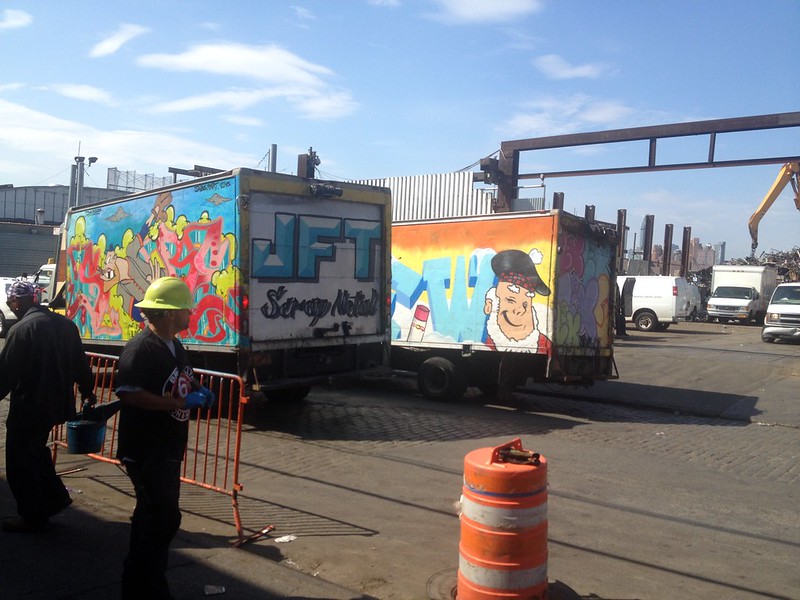
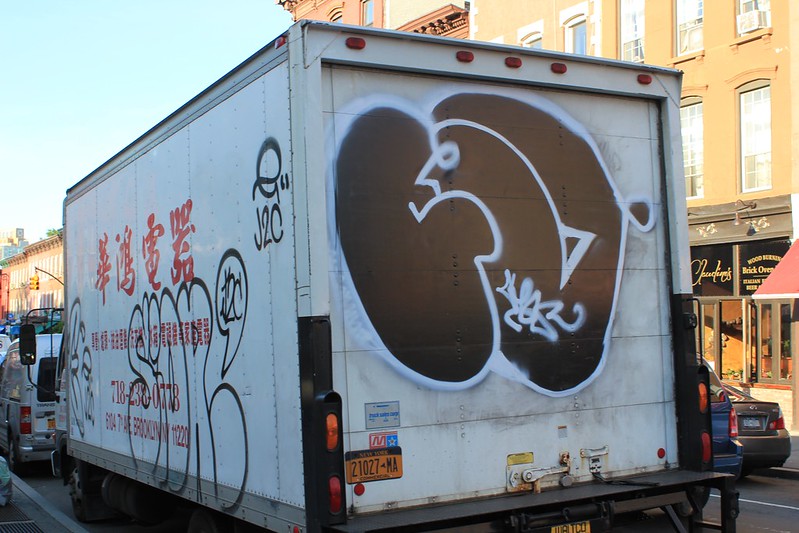
I also get down to Gowanus fairly regularly, where our local scrap metal recycling concern was host to not one but two trucks last month.
IMG_3174

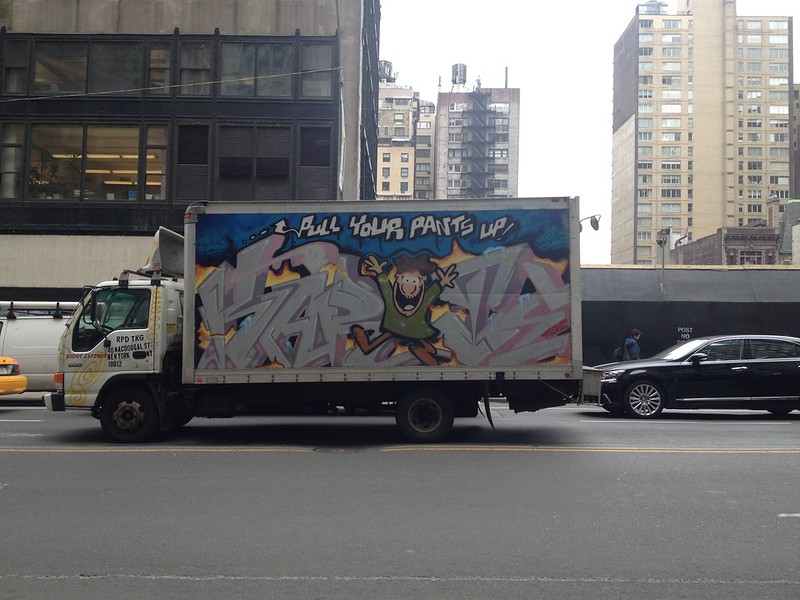
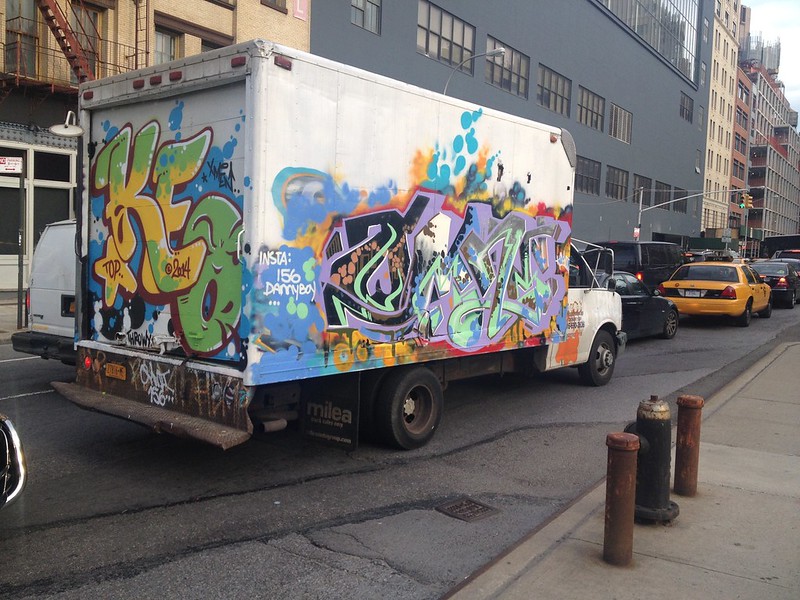
Beyond the occasional tag, you'll never find any decent graffiti on 57th Street, aka land of the billionaire's lairs. But keep your eye open on the traffic...
IMG_2713

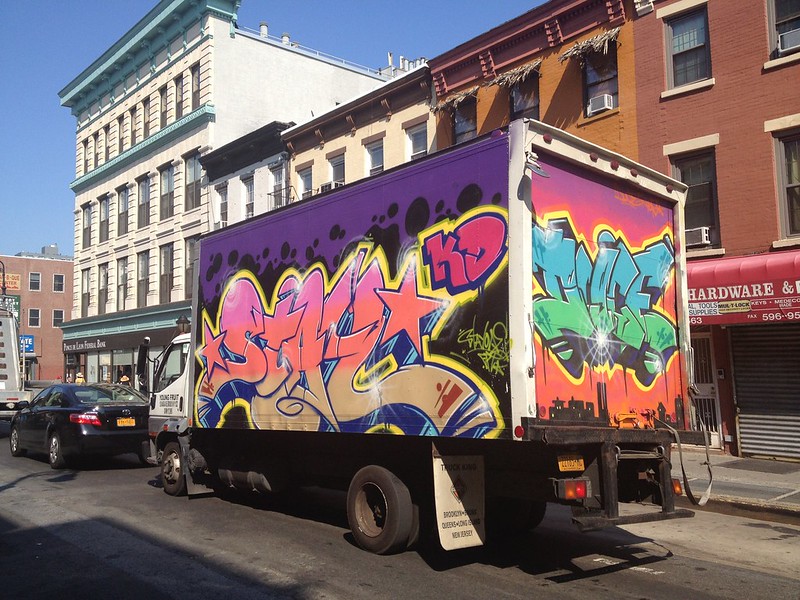
Some times I need only walk out the door onto Smith Street to catch a glimpse of something awesome.

IMG_0648

Now, graffiti is that unlike most art forms, in that its public nature dictates that the best of the best gets mixed in with crap, as there are no barriers to keeping out the latter. This is true of trucks too:

SAM_1054
Um, ok....

IMG_2436 Eh....

IMG_2999 Did we not finish this one? Note the reference to Instagram....
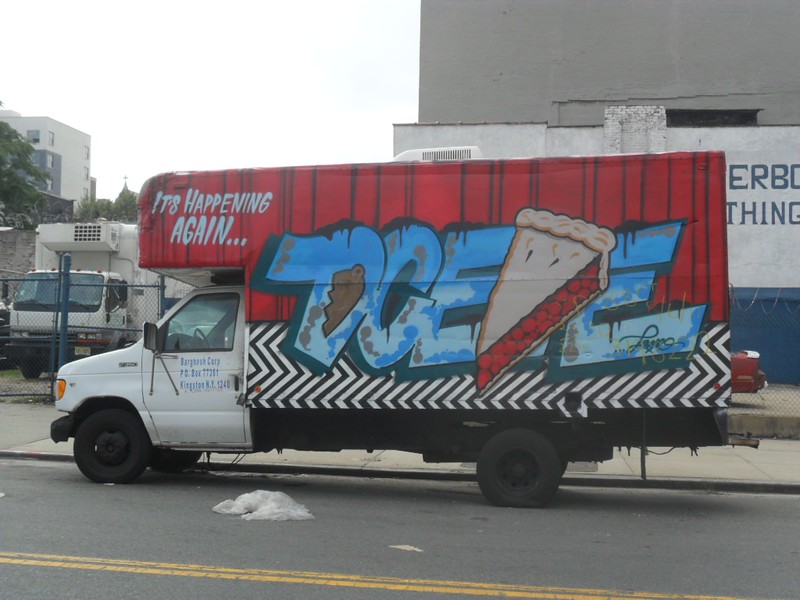
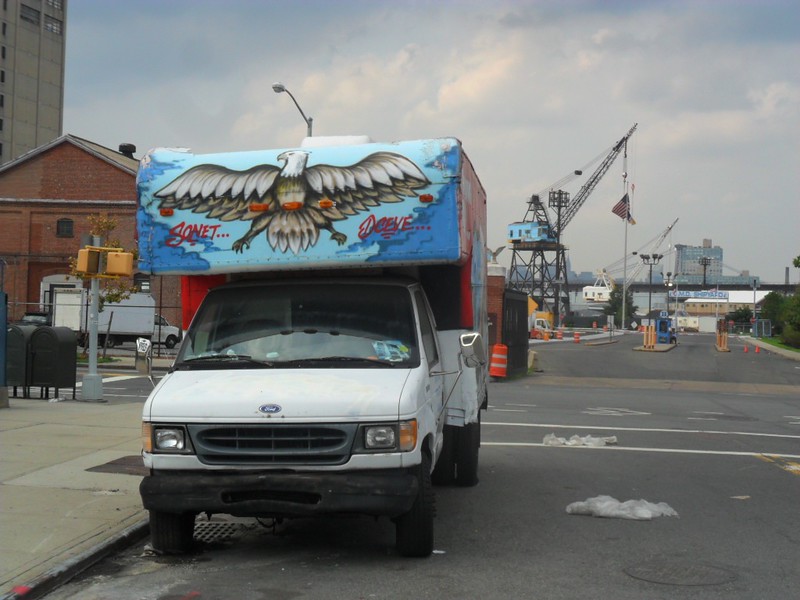
SAM_0823 But when they're done right, trucks with murals are like the perfect amalgamation of motion, pizzazz, and whimsy. This van, which was done by the Smart Crew, was parked in the shadow of the Navy Yard.

SAM_0824
'Merica!
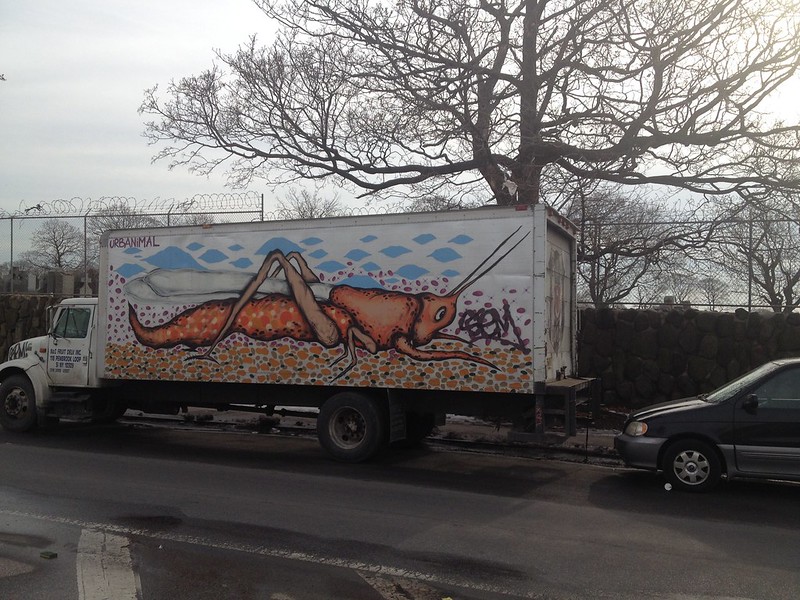
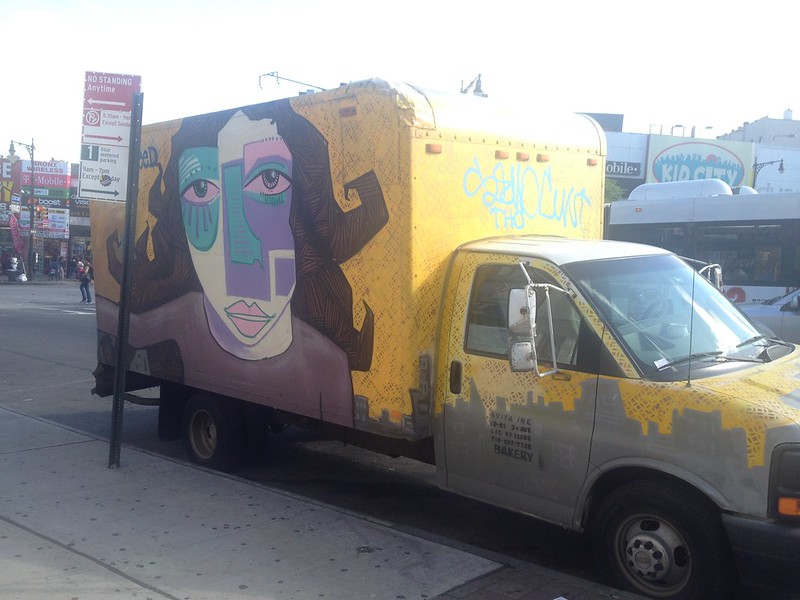
IMG_2401 Grasshopper, from Urban Animal, on Queens Boulevard. IMG_3028 Spotted this truck on Fordham Road.

I could go on and on here, but you get the general idea. Although the New York City's robust building mural scene is confined to a handful of neighborhoods, mostly in the outer boroughs, thanks to the equally bustling truck scene, graf is well-served to both well-heeled and down and out New York City hoods. Like food trucks, but with vittles for the creative soul..
IMG_1625

Fruit truck, Bed-Sty

Thursday, May 15, 2014

Cowabunga!

Ai yai yai, I just realized it's been exactly two months since I last posted. Sorry about that, Politics of Global Economic Relations really took a lot out of me. Great class, and I learned a lot about foreign direct investment, trade investment, and exchange rates, but it was definitely a steep learning curve. I basically never spoke in class, and instead just tried as hard as I could to sop up all the information flowing around me. Ask me about the World Trade Organization, the GATT and the Bretton Woods Agreement sometime!

So now it's time to buckle down and transform the thesis into a book. This is basically going to take all the summer, so I'll be referring to it here a lot, but I imagine I'll leave a lot on the cutting floor, lest I share too much that will end up in the book. I do want some people to buy it, you know?

In the mean time, I've been trying to keep at least one ear on the current street art situation in New York, which like the rest of the city is always changing fast. I've paid visits to Welling Court (with my daughter Eliza in tow) and the Bushwick Collective recently, though it's been much harder to visit anywhere in the Bronx, upper Manhattan or New Jersey.  Comes with living in Brooklyn, I guess.


A few articles that have caught my eye, either from the folks at Brooklyn Street Art, Street Art NYC, Luna Park, or Graffiti New York:

The New Must-Have for Luxury Buildings: Graffiti
Solid reporting, and super depressing at the same time. I've seen 40 Bond up close, and I think I've even taken pictures of the spaghetti-like scrim that lines the front. And while I actually think it's kind of a neat accoutrement, I never once mistook it to be related to graffiti. Fortunately, no one seems to really take seriously the developers' assertion that it represents a "downtown-on-the-edge point of view," whatever the fuck that means. In my business, we call that a word salad with a heaping side of bullshit.

I'm on this guy Niklas Maak's side:

“What they pioneered as a form of protest is transmuted into a fortification that prevents them from spraying onto the actual façade,” he says. 

I also find it amusing that the  word “NO” written in dark-orange spray paint, is somehow seen as "edgy" for a development in DUMBO, the single most expensive neighborhood in Brooklyn. How, exactly, is this any different from leaving the remains of a antique advertisement for Ma Bells' Miracle Cream? You're looking at a remnant, you dolts, nothing more. Talk to me when you live the way the folks do at 190 Bowery.
190 Bowery, a/k/a the coolest house in Manhattan
Final thought: I'd like to ask author Elizabeth Greenspan if she's ever left Manhattan. Because when I read "Meanwhile, the kind of graffiti for which New York is most famous—tags wallpapering subway cars and city walls—has largely disappeared," I laughed out loud. Yes, tags are gone from subways. But walls? Oh, honey, come on out to Brooklyn some time, and I'll show you OODLES of tags. You won't even have to go all the way to East New York, I promise!
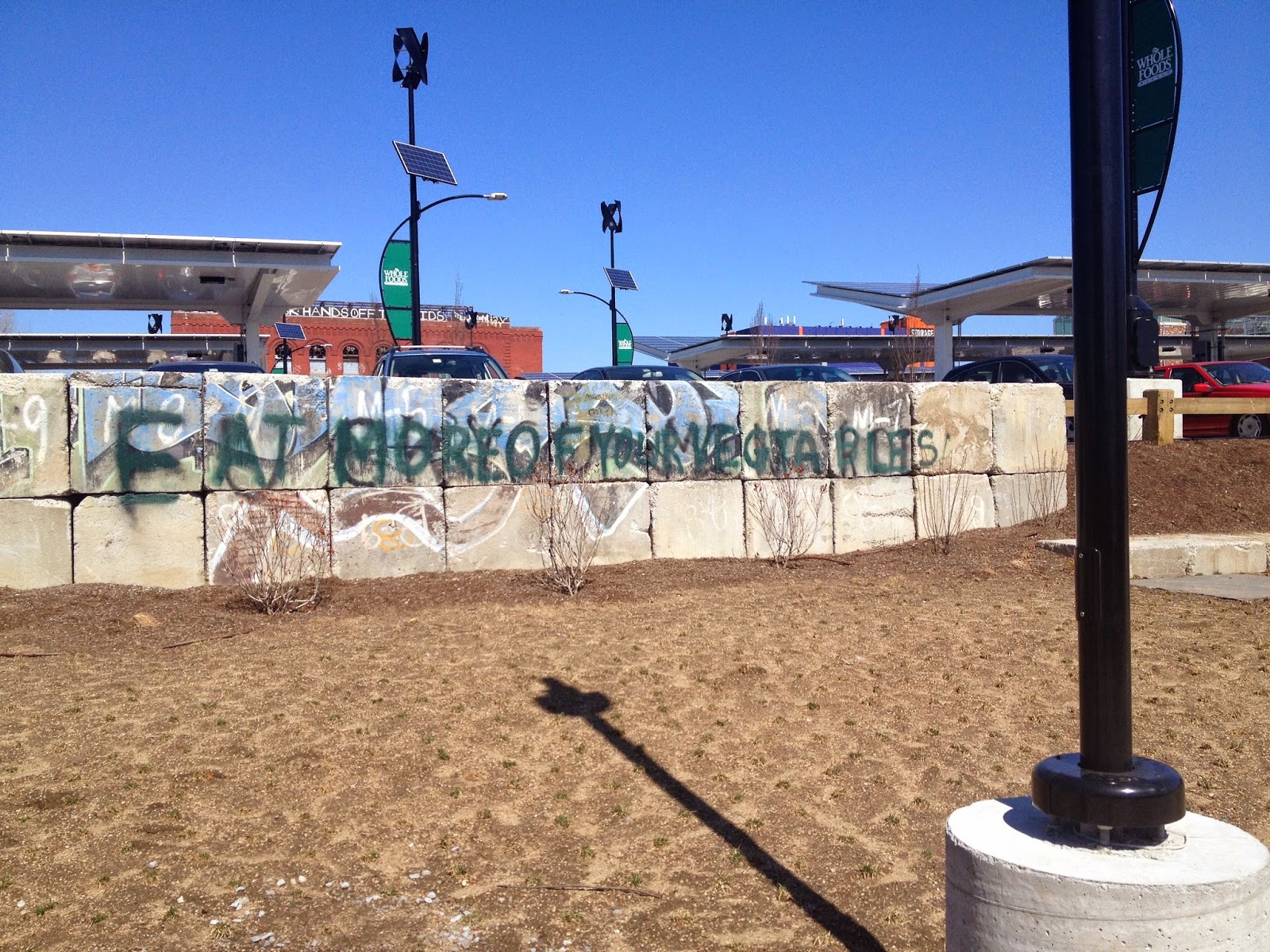
That's right they even have graffiti at Whole Foods in Gowanus.
Eat more of your vegetables!
But don't take my word for it. Even new NYPD honcho Bill Bratton agrees! I'm not sure how I feel about his assertion that graffiti is growing in NYC and "as a city, we need to basically take it on because that’s the first sign of urban decay.”

On the one hand, he's parroting the same old "Broken Windows" theory that law enforcement refuses to let go of, in spite of the fact that the theory has been proven to be wrong. I mean, Greenpoint, Williamsburg and Bushwick are dripping with graffiti these days, but do you hear anyone worrying about how these three neighborhoods are spiraling into hellish crime zones? Anyone? Bueller?

Tags? What tags? That stuff's gone yo!
The optimist in me hopes that this means a guy like Bratton might be open to exploring new ideas for combating vandalism, including murals. I mean, it's already being done on a large scale at the Bushwick Collective, and on smaller scales like this mural in the Bronx. Hell, even Amtrak is getting into the art game! The pessimist sees a guy who made his name in the 90's stamping out "Quality of Life" crimes in NYC, and like so many others, he may view the problem as one of enforcement, and nothing more.
Robots Will Kill's latest addition to Bushwick. I can see it now:
"You know, we really like the face, but can you do it more, "sideways"?
Fingers crossed!


Thursday, June 20, 2013

5 Pointz (Pt. III)

So we've come to the end of the road for my essay on 5 Pointz. And as chance would have it, an article about the building's impending demolition has come to my attention. It's called LIC Parents: Demolish the 5 Pointz Building, Save the Graffiti, and and while the premise behind it is interesting, the tone of the letter is jaw dropping.

On the one hand, it's true that MoMa's high concrete walls would make a great canvas, both for their size and their visibility. So kudos for trying to think of something, anything that might preserve some of the painting. That said...

Um, don't you think maybe someone might have already thought of this? It's so obvious, how could it not have been brought up? Gee, I wonder why it might not have gone forward? Maybe because, large as the walls are, they're still a teeny tiny space compared to 5 Pointz. It would be like taking away someone's chalk board and handing them a note pad and then expecting them to be happy. Not that the folks from the LIC Parents' group are actually interested in promoting graffiti murals:

"Could there be a better synergy than between MOMA’s high concept art and mind-numbing street art of the aerosol kind?" (emphasis mine)

Uh yeah, mind numbing is the first thing that comes to mind when I see things like this:

SAM_0990

Seriously, when your hostility to the form is that hard to repress, why even bother pretending you care?

Then there's this:

"They were generous (and a bit clever) by parceling up brittle floors with drafty windows into artist studios and renting the spaces at rates that few real businesses would be willing to pay."

Excuse me? Have they never heard of building owners renting out old buildings to artists until they can scrape together enough capital to renovate or replace the building and thus charge more rent? This aspect of 5 Pointz is not new or particularly unique. What is unique is the skin of the building, which I explore in more detail below.

All I can say is this is a depressing example of the ignorance that can be found in many corners the city. When you're in thrall with an art form, it's easy to assume that others dig it too. Alas...

Anyway, on to part III!


And what of the self-appointed curator of 5 Pointz? When asked why a place like 5 Pointz might be important, with its multitude of pieces presented together on nearly every conceivable space, MeresOne speaks not as someone concerned with the overall look; but as a promoter of a culture near and dear to him.

It’s about people, you know?  It’s more enjoyable; it’s kind of boring to [paint] alone. It’s not a gang or anything; when they paint, they just get together and do a wall.  (From an interview on Dec. 9. 2009)

Speaking with a croak that suggests he’s perhaps spent a few too many days painting without a mask, Meres also joked that one of the reasons why graffiti artists crave outdoor spaces like the walls of 5 Pointz and countless other mural locations over indoor spaces, is it’s better on their lungs. But of course, it’s really just a simple matter of being seen by an audience that’s either large or influential, the latter being other writers and fans of graffiti.

If you’re there, other people will be there, and they may say ‘Wow, there’s a piece where I didn’t expect to see it.’ I’ve done some spots where you’re out in the woods, like along in Jersey, you walk through a park, you ended up behind a factory. (From an interview on Dec. 9. 2009)

MeresOne estimated that 5 Pointz hosts 1,000 different pieces annually, with many writers returning to the space over and over. He didn’t say as much when he cited that number, but I suspect that doesn’t include installations such as one that I witnessed in person—A red and white blocky “Ricoh,” whose outline he painted on the southwest corner of the complex in December 2009.

Visitors take turn "tagging" the Rico logo
When I visited the site then, a group of about 25 visitors who’d piled out of a tour bus were taking turns filling in the outlines of the letters with red spray paint, while posing for pictures. “Tagging,” it seems, is something that people will pay for the privilege to do, as MeresOne said they’d compensated him for allowing them to try their hand at the famous 5 Pointz. After they left, he quickly spray painted over it again, creating a space ready for a new, less commercially infected creation.

MeresOne has wrestled with the competing interests of art and commerce, on the one hand trumpeting the validity of graffiti and the importance of 5 Pointz, and then accepting money from groups with no interest in creating art. He is not wrong to take money to support the greater cause of 5 Pointz, (as recently as November 8, 2012, 5 Pointz was featured on the TV show Project Runway) as he supervises the space for no salary.

When he explains the logic behind taking money from the likes of Ricoh, he pins some blame on Wolkoff’s greediness. This might come across as sour grapes from someone who has enjoyed a free lunch, but it’s worth noting that Wolkoff let the building fall into such disrepair that an outdoor stairwell collapsed in April, 2009, seriously injuring one of the Crane Street Studio’s artists. This lead to the eviction of the studio, and the building has sat largely empty ever since.

This raises the possibility that Wolkoff allowed 5 Pointz to fall into disrepair, thus making it easier to justify knocking it down and building something radically different in its place. In a sense, it’s a moot point though; the aforementioned rezoning gave an official blessing to the eventual demolition of the building. MeresOne may be living in a world where he has to cater to corporate tourists in order to keep his operation going, but Wolkoff is a developer in a town where, as noted earlier, the demand for housing is astronomical.

When he’s asked about the loss of the tenants of the Crane Street Studios, MeresOne is not terribly moved.

Q: Have things changed much since the closing of the studios inside 5 Pointz?
A: Not really. I don’t have to be as conscious if the radios are as loud outside, now we can turn the music on as loud as we want to. Otherwise it’s the same. There were some hypocrites who were two-faced, they’d say hello and then talk down on us and label us. So at times that would happen. 
(From an interview on Dec. 9. 2009)

If MeresOne is a little too caught up in the importance of his art to the exclusion of others, Wolkoff is much too confident that he can incorporate the past into the present. In a New York Times article about the impending demolition, he revealed that the space reserved for the graffiti artists would be a rear wall. This cannot be seen as anything more than a token gesture, akin to a scale model of the original Waldorf-Astoria hotel stored in the lobby of the Empire State Building. 
   
For the time being, the painting continues unabated, as writers can be seen daily adding layer upon ultrathin layer to the outside of a crumbling leviathan. The future of this state of affairs is in doubt, but even without the aid of architectural renderings of Wolkoff’s planned development, it’s possible to get a sense of say, the year 2016 by standing at the corner of Jackson Avenue and Crane Street and facing west toward the Citicorp Tower. Verticality is key, not spontaneity. Monetary capital will triumph here, as neighborhood cultural capital will be ceded to more trusted keepers at PS 1.

The past is the foreground; the future is the background.
 For now, the contrast between the squat, crumbling stone building with an ever changing skin and the cool, shimmering tall glass tower just down the street, can be illustrated neatly by Koolhaas’s explanation of the work of architect Hugh Ferriss, who first envisioned New York as the “mega-village.”

Ferriss’ most important contribution to the theory of Manhattan is exactly the creation of an illuminated night inside a cosmic container, the murky Ferrissian Void: A pitch black architectural womb that gives birth to the consecutive stages of the skyscraper in a sequence of sometimes over lapping pregnancies, and that promises ever new ones. 

One57, dubbed the "Billionaire's Haven," under construction
in July, 2012
It is important to note that this is a New York City where humble buildings such as 5 Pointz are 15 minutes from not only cultural beacons such as Carnegie Hall, but also out of this world havens where 11,000-square-foot duplex apartments now sell for $95 million. So it is depressingly understandable that Ferriss’ vision of a void that encompasses all of the Manhattan sky, just waiting to be taken over by successive skyscrapers, extends across the East River into Queens, a borough known more for its parkland and polyglot immigrant population than its skyline.

The “Ferrisian void” that will be filled between Crane and Davis Street in Long Island City may not contain the space of business the way its glassy neighbor to the west does, but in the scope of filling the void, and adding bulk to fill in the “cosmic container,” it is no different.

When the wrecking ball finally meets 5 Pointz, and the name, which is an ode to New York City’s five boroughs, is either retired or transferred by MeresOne to some other destination, what replaces it will pail in comparison, if for no other reason than its replacement will sync with the demands of monetary capital and the void will be overwhelmed with space primarily for generating profit. Among the oppositions that will disappear from the scene is change: The morphing, “that wasn’t there last week” quality of the vast canvas that is the exterior will be replaced by something static and predictable.

To expect anything less from residents within would be unrealistic. Wolkoff might truly believe he’s honoring the energy and history of graffiti by providing a space for future artists work, but unless it’s a space that is visible from the elevated 7 train and the myriad passersby in the neighborhood, it won’t be any more appealing to graffiti artists than the dozen or so spaces around the city that are also open to artists in the know.

A corollary might be the punk rock club CBGB, which closed in 2006 and was replaced 18 months later by high-end clothing John Varvatos store, which peddles $250 shirts. Remnants of the original institution remain, but it is an echo from the past, useful for reminiscing perhaps, but not much else.
A visitor takes in the site.


Tuesday, June 11, 2013

5 Pointz (Pt. II)

And now, part two of my ruminations on 5 Pointz, a/k/a  "The Institute of Higher Burnin." If you've never been, I can't recommend it enough. I've been stashing pics of it from my various visits here.

One of my all time favorites is this:
SAM_0992

Enjoy!

This segues nicely into Rem Koolhaas’ discussion of the model of “Manhattanism.” Koolhaas is known as an architect responsible for unorthodox buildings like the CCTV Headquarters in Beijing, but he has also meditated intensely on the zeitgeist of New York City development. In a chapter where he discusses how the Waldorf-Astoria hotel’s predecessor was demolished to make way for the Empire State Building, he notes:

The model for Manhattan’s urbanism is now a form of architectural cannibalism: By swallowing its predecessors, the final building accumulates all the strengths and spirits of the previous occupants of the sight, and in its own way, preserves their memory.

In the case of 5 Pointz, the space has been used as a cultural one since 1993, when Pat DiLillo, an artist in the Crane Studios, convinced owner Jerry Wolkoff to let graffiti artists paint the exterior. Wolkoff’s son David eventually took over, and gave his blessings to Jonathan Cohen, an artist who goes by the tag “MeresOne” and who changed the name from Phun Factory to 5 Pointz.

In interviews, David Wolkoff has expressed sadness that the building would have to come down, but noted that it would be prohibitively expensive to repair it so that it would be habitable again. While shrugging off complaints from neighbors critical of his decision to turn over his building to artists wielding those spray cans, he is also clear about what he sees as his role:

We’ve allowed them to have a safe haven to do their work, and now as a developer I have to be allowed to do the work I do, to create what I consider art, which is building buildings — which is an art form as well as an economic driver.

In the same interview, Wolkoff expressed confidence that the loss of the building wouldn’t leave the neighborhood bereft of art, citing PS 1’s presence. His view of that museum as an adequate replacement is unfortunately echoed by Joe Conley, chairman of the Community Board 2, which includes the building.

I can’t see that the community would lose anything with that building. It’s an outdated building, it’s from a bygone era, and it’s certainly not the efficient use of space.

To be fair to Wolkoff, he has also stated publicly that he would like to incorporate artists’ work into the new development, which would be made up of a 47-story tower and a 41-story tower, together encompassing 1,000 rental units and 30,000 square feet of retail space. And this is where the concept of Manhattanism’s “architectural cannibalism” comes into play.

Given the enormity of the project and the fact that Wolkoff is planning to build residential space in place of industrial space, it’s almost laughable to think the same sort of artistic freedom could abound in a place that Wolkoff told WNYC could have a gym, a pool, a billiards room and a supermarket.

But just as Koolhaas documents that the majestic Waldorf-Astoria was seen as a fitting site for the Empire State Building, so too does Wolkoff believe that his towers will, in Koolhaas words, “accumulate all the strengths and spirits of the previous occupants of the sight, and in its own way, preserve their memory.”

100_0563


Next: MeresOne, the pressures of capital, and the future.

Thursday, June 6, 2013

5 Pointz (Part I)

Aaaaaaaand, we're back to the graffiti. Woo!

So, just as I dedicated my last few few entries to the final paper for my last class, "Urban Political Processes," these next three come to you via "New York City Arts and Urban Expression," which I took in the fall.

I'd written a good chunk of it for "Issues In Urban Studies," the first masters class I took at Fordham, in the fall of 2010, but wasn't entirely satisfied with how it turned out. So I added a lot more theory, some excellent ruminations from Rem Koolhaas, and more details about the planned demolition of the site. This is one of the unintended perks of spreading studies out over five years-you get to revisit past projects and build on previous work.

Unlike the piece on public housing, I was able to include this paper my thesis as sort of a bonus chapter. It's very different from the other case studies in my thesis, but I think that's just as well. 5 Pointz is in a class of its own in the NYC graffiti world, so it deserves its own treatment. Hopefully you'll think so too.

Enjoy!

Five Pointz
Fifteen minutes. That’s the amount of time it takes to get from Carnegie Hall, in glitzy Midtown Manhattan, to 5 Pointz, in gritty Long Island City. On a weekday afternoon, the 500,000 square foot former warehouse colloquially known as the “Institute of Higher Burnin” can be visited from Carnegie Hall during lunch hour, via the E train, which drops one off all of two blocks away, at the 23 St/Ely Ave stop.

5 Pointz, as seen from under the elevated 7 train
The M train, which passes through Rockefeller Center, likewise stops at 23 St/Ely Ave. Or for those who are closer to Grand Central Terminal or Times Square, there is the elevated 7 train, which slowly creaks around the buildings’ southeast corner on a serpentine track and stops at Court Square, also two blocks away.

Fifteen minutes by subway. In the scheme of New York City real estate, and the dreams, visions and fantastical amounts of capital cycling through regions in such close proximity, 5 Pointz never stood a chance. In July 2001, the city government signaled as much, when it included the building in a 37 block rezoning, adding it to the three block area that was rezoned in 1986 for the high density development that facilitated the construction of the 1.25 million square-foot Citibank tower.

At the time, the plan was such:

In the Long Island City core, the rezoning replaces existing low density light manufacturing zones with higher density, mixed commercial and residential zones to allow as-of-right developments, including office buildings with large, efficient floor plates.

City planners at the time were not thinking strictly in vague terms that would be sorted out by the forces of the market; as the second page of the aforementioned document contained a graphic that helpfully identifies sites ripe for development. In the bottom right corner is a figurative bulls eye on 5 Pointz.

5 Pointz can be seen in the lower right corner.
From "Long Island City Rezoning: Executive Summary."
And so, some 12 years later, 5 Pointz, which began its current incarnation as a graffiti magnet as the “Phun Factory” and for a spell housed a vibrant artist colony called Crane Street Studios, has a date with the wrecking ball, destined to join countless art meccas cleared out in the name of progress.

But I digress. Although the fate of 5 Pointz has seemingly been sealed, the space is still worth a critical look, both in terms of its contributions as a node of a global graffiti community that still practices a great deal of its craft in the shadows, and its relation to the city’s larger fabric. Before going into greater detail about the building, some theoretical framing is useful.

For starters, the French philosopher Michel Foucault addresses something that is often left unsaid when assessing the merits of public spaces: It is not important that a building or space is constructed in a particular fashion; what matters most is how space is experienced by people. He writes:

Our life is still dominated by a certain number of oppositions that cannot be tampered with, that institutions and practices have not ventured to change—oppositions that we take for granted, for example, between private space and public space, between family space and social space, between cultural space and useful space, between the space of leisure activities and the space of work. All of these are still controlled by an unspoken sacrilization.

The Citicorp tower looms over the diminutive 5 Pointz
Oppositions that separate 5 Pointz from the surrounding neighborhood are numerous, and helpful to mention, because they locate the building within its context. There is the obvious, in the painted figures, glyphs and texts that cover well over half the surface of the complex. This opposition is in fact its defining feature within all of New York City—there are spaces dedicated to graffiti scattered all around the five boroughs, but none rise five stories from the ground and wrap around 3/4ths of a city block. But there are other less obvious oppositions. There is purpose: This building was constructed for light manufacturing; as noted above the area has been rezoned to exclude this kind of space.

More preferable are structures like the 50 story Citigroup Building. There is the chaos of the space, when compared to PS 1, the satellite of MoMa that is stationed across Jackson Avenue. Whereas P.S. 1 sits seemingly in calm repose, behind clean concrete and a simple white façade, 5 Pointz is a garish mish mash of the low brow, high concept, simplistic and astonishingly complex. It also functions as a gallery turned inside out—whereas most spaces exhibit art inside, 5 Pointz’ exterior is the gallery.

P.S. 1, ensconced safely behind concrete walls across the street
from 5 Pointz
Additionally, the building is—thanks to its mass, color, outlet and location—a bone fide landmark that draws visitors from around the globe to see it. Although the art at PS 1 is no doubt impressive, and the architecture of the Citigroup Building is visually arresting (mostly because it stands so freakishly out of proportion with everything else), neither can compare to the uniqueness of 5 Pointz, with an exterior that changes almost as often as the seasons. It is akin to a chameleon, a living creature that alters its skin as it sees fit.

Unfortunately, one final opposition also exists, which is to say official recognition. PS 1 has existed since 1971, and has been affiliated with the Museum of Modern Art since 2000. Citigroup is a multi-national financial services company with 260,000 employees that was founded in 1812. The former institution is lauded as the type of culture inherently desirable to the city, whereas street art and graffiti get little to no official support from the city. The latter? As noted before, in form if not function, its space represents the high water mark for the city, which is to say maximum capital exerted from the space.

Next: Rem Koohaas' "Manhattanism" and the folly of the Wolkoffs.


Friday, October 26, 2012

And now, back to our regularly scheduled program

Is there anything less interesting than catching a common cold? Well, I suppose yakking about it via social media....

Yeah, so I missed three solid days of writing, thanks to coughing, fatigue, runny nose, sore throat, yadda yadda yadda. Thankfully, Dayquil, Niquil, OJ, leftover prescription strength cough medicine and sleep seem to have done the trick, and I'm back in business today.

I'm not writing about Groundswell or the D.O.T. though; rather I've shifted gears toward something else, and will return in a day or two. Because in addition to finishing this thesis, I'm also taking a class, New York Arts and Urban Expression. I don't have time here to explain exactly what that class is, but what's important is the final paper for the class is due on November 13. Yes, there are three more classes after that—don't ask....

Like most classes in the Urban Studies masters program, this one has a professor who's eager to help us complete our thesis, so I've taken this opportunity to add a chapter to mine that I thought I might have to leave out: The world famous Five Pointz, located all of 15 minutes from Midtown Manhattan, in Long Island City. Here's a shot I got yesterday:


There's a shit ton of other pictures over at my Flickr set, including few pictures that aren't really focused on graffiti, per se. Like, for instance, this shot. That's because I'm going to focus a good deal on the relationship between this building's community, which will be scattered to the the four winds next fall when it's scheduled to be demolished, to the one affiliated with the Citigroup Building three blocks away. Basically, I have to somehow marry reporting and research on the "Institute of Higher Burnin'" as 5 Pointz known, to theory from the likes of Foucault, Derrida and Koolhaas.

From the latter, here's a quote from his tome, Delirious New York, which I highly recommend:


“Ferriss’ most important contribution to the theory of Manhattan is exactly the creation of an illuminated night inside a cosmic container, the murky Ferrissian Void: A pitch black architectural womb that gives birth to the consecutive stages of the Skyscraper in a sequence of sometimes over lapping pregnancies, and that promises ever new ones.” —P. 117

Should make for an interesting chapter.

-PV

P.S. I apologize for the blandness of the photos; I took them with my trashy little point-and-shoot instead of my SLR. Won't happen again!