Sunday, June 29, 2014

To be unexpected

Editing of text? Check.  Foot notes converted into end notes? You betcha. Academic jargon stripped? Well, sort of. There's still a lot left in the manuscript, and that's how I likes it. Gotta say more than just "Graffiti murals are cool, here's how some of them came to be," right? It's always painful to revisit words written a long time ago, even if that "ago" is less than five years; and indeed, some of what I wrote for my thesis, I can't even begin to wrap my head around. Needless to say, that was the easiest stuff to scrap.

Now I'm in the middle of a much less fun part: Pictures. Ugh. Along with a manuscript, I have to turn in a disc with all the images titled properly, along with a spreadsheet with corresponding captions, and if necessary, photo release forms. The rule for the latter is that if a picture was taken by me on private property, or if the picture belongs to someone else, then I need to get permission. If it was taken by me on public land, then it's mine to do with it what I please. Thankfully, roughly 75 percent of the images I want to use fall into the latter category. But I'm still going to have to wrastle up a few forms from folks.

Then there's the issue of photo quality. Some images aren't high res, and some, like this one, just aren't as good they should be (chain link fence in the front, shadows in the back). What can I say, I never really imagined I'd be considering this sort of issue when I embarked on the thesis four or so years ago.

So I'll be making a few trips to Inwood and possibly Staten Island in the next few weeks to snap a few more pics. I won't bore ya'll with the ins and outs of securing permission from folks to use their pictures or get proper captions; needless to say, I feel like I'm really close to being done. Formatting the text properly and making sure the new art goes where its supposed to is going to be very un-fun, but I've got a whole month left to make it happen.

Anyhoo! Saw this little guy earlier this month on a run through DUMBO:
If you've read much of my blog, you know I'm a sucker for figures in graffiti, and this has the added value of being somewhat cheeky and cute at the same time. And low and behold, Luna Park has written about him on her invaluable Street Spot blog. Apparently many pieces from Art is Trash are literally assembled out of trash, which makes them especially fleeting in nature. I like that notion; it's very much the way that New York City works. It can be jarring to see things come and go so quickly, especially when they're restaurants or stores that have been around forever (ahem, J&R, Pearl Art), but it's also what keeps things fresh.

But with all due respect, I'm not sure I agree that there's a need for an antidote for permission walls, at least not down this way. Mind you, I understand where her rationale from. A visitor to Williamsburg, Greenpoint or Bushwick these days can easily become overwhelmed by street art of all stripes; I know this because when I visit there, I hardly know where to look first. It's fair to say northern Brooklyn, the epicenter of NYC street art, is close to a saturation point. And this is coming from someone who likes this stuff.
Y'all sure ya didn't miss any spots there, eh?
It's an unfortunate reality of New York right now: Some places are filled to the rafters with street art, both sanctioned and unsanctioned, and others, like say, Sunset Park, are pretty much barren. Even down my way, Gowanus has a pretty sparse selection of inspiring graffiti. Sure, we get interesting entries here and there, like this, but rarely anything that makes you just go 'Whoah."

Well, until now. A few weeks, ago, I went for a run along Nevins Street, and stumbled on this, on the side of the Lower East Side Ecology Center's e-waste warehouse. Yes, I know the Lower East Side is in Manhattan. Haven't you heard everyone's moving to Brooklyn? I've dropped off various electronic gadgets here, and always thought this wall would be a great one for a mural; It's large, flat, blank and it's often tagged by random writers.

Apparently the good folks the Wallnuts thought so too. 
Werc Hernandez
I haven't been down to the wall since June 2; in that time the wall has had much, much more added to it. I can't wait to get back down there to see the finished product. I would imagine many people will be stopping and lingering awhile to see what is a bit of a rarity here, and which, for me, was as pleasant a surprise as the Art is Trash piece. Which just goes to show, as long as you don't overdo a good thing, it can retain the ability to amaze, impress and inspire.


Thursday, May 15, 2014

Cowabunga!

Ai yai yai, I just realized it's been exactly two months since I last posted. Sorry about that, Politics of Global Economic Relations really took a lot out of me. Great class, and I learned a lot about foreign direct investment, trade investment, and exchange rates, but it was definitely a steep learning curve. I basically never spoke in class, and instead just tried as hard as I could to sop up all the information flowing around me. Ask me about the World Trade Organization, the GATT and the Bretton Woods Agreement sometime!

So now it's time to buckle down and transform the thesis into a book. This is basically going to take all the summer, so I'll be referring to it here a lot, but I imagine I'll leave a lot on the cutting floor, lest I share too much that will end up in the book. I do want some people to buy it, you know?

In the mean time, I've been trying to keep at least one ear on the current street art situation in New York, which like the rest of the city is always changing fast. I've paid visits to Welling Court (with my daughter Eliza in tow) and the Bushwick Collective recently, though it's been much harder to visit anywhere in the Bronx, upper Manhattan or New Jersey.  Comes with living in Brooklyn, I guess.


A few articles that have caught my eye, either from the folks at Brooklyn Street Art, Street Art NYC, Luna Park, or Graffiti New York:

The New Must-Have for Luxury Buildings: Graffiti
Solid reporting, and super depressing at the same time. I've seen 40 Bond up close, and I think I've even taken pictures of the spaghetti-like scrim that lines the front. And while I actually think it's kind of a neat accoutrement, I never once mistook it to be related to graffiti. Fortunately, no one seems to really take seriously the developers' assertion that it represents a "downtown-on-the-edge point of view," whatever the fuck that means. In my business, we call that a word salad with a heaping side of bullshit.

I'm on this guy Niklas Maak's side:

“What they pioneered as a form of protest is transmuted into a fortification that prevents them from spraying onto the actual façade,” he says. 

I also find it amusing that the  word “NO” written in dark-orange spray paint, is somehow seen as "edgy" for a development in DUMBO, the single most expensive neighborhood in Brooklyn. How, exactly, is this any different from leaving the remains of a antique advertisement for Ma Bells' Miracle Cream? You're looking at a remnant, you dolts, nothing more. Talk to me when you live the way the folks do at 190 Bowery.
190 Bowery, a/k/a the coolest house in Manhattan
Final thought: I'd like to ask author Elizabeth Greenspan if she's ever left Manhattan. Because when I read "Meanwhile, the kind of graffiti for which New York is most famous—tags wallpapering subway cars and city walls—has largely disappeared," I laughed out loud. Yes, tags are gone from subways. But walls? Oh, honey, come on out to Brooklyn some time, and I'll show you OODLES of tags. You won't even have to go all the way to East New York, I promise!
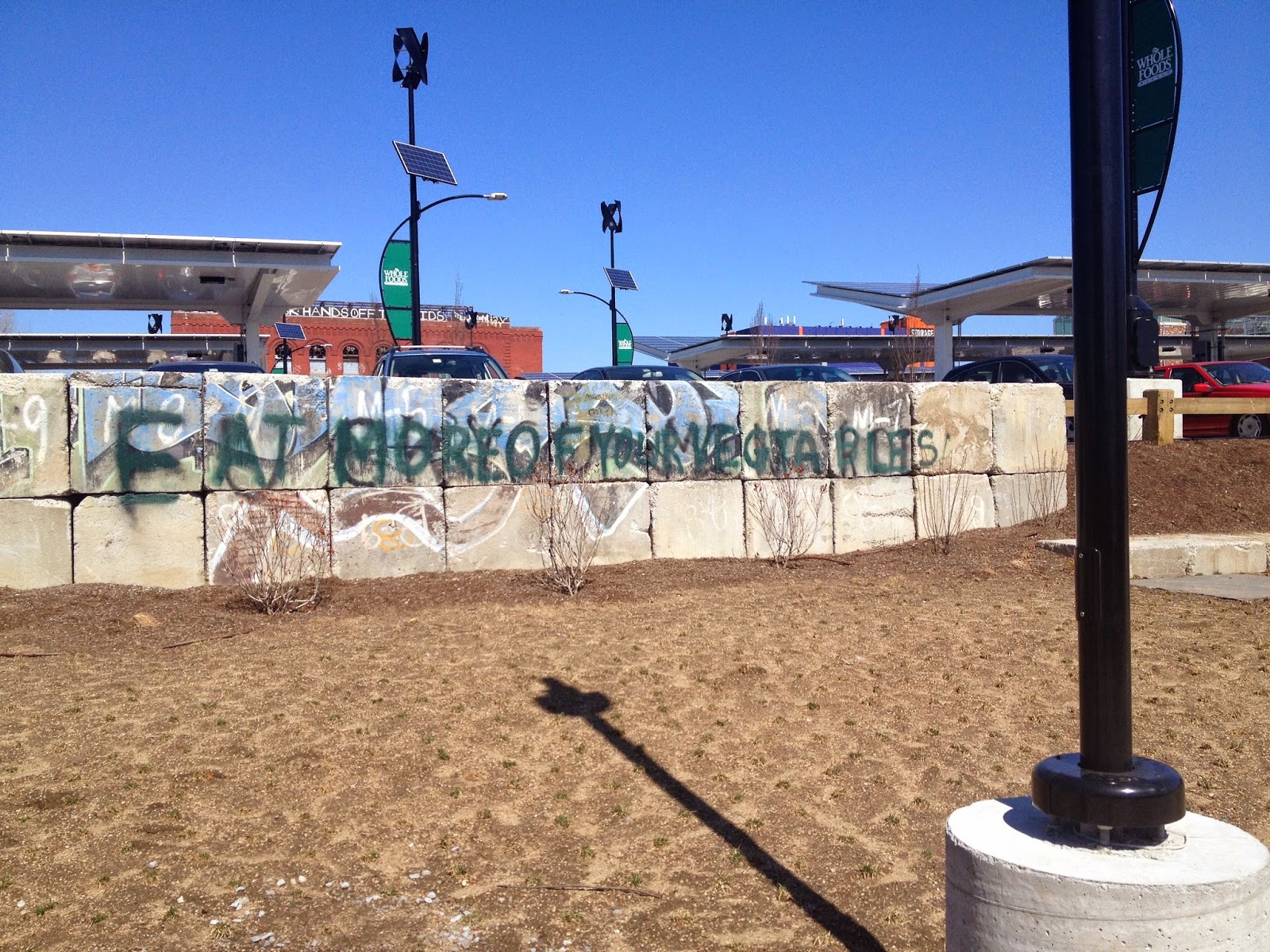
That's right they even have graffiti at Whole Foods in Gowanus.
Eat more of your vegetables!
But don't take my word for it. Even new NYPD honcho Bill Bratton agrees! I'm not sure how I feel about his assertion that graffiti is growing in NYC and "as a city, we need to basically take it on because that’s the first sign of urban decay.”

On the one hand, he's parroting the same old "Broken Windows" theory that law enforcement refuses to let go of, in spite of the fact that the theory has been proven to be wrong. I mean, Greenpoint, Williamsburg and Bushwick are dripping with graffiti these days, but do you hear anyone worrying about how these three neighborhoods are spiraling into hellish crime zones? Anyone? Bueller?

Tags? What tags? That stuff's gone yo!
The optimist in me hopes that this means a guy like Bratton might be open to exploring new ideas for combating vandalism, including murals. I mean, it's already being done on a large scale at the Bushwick Collective, and on smaller scales like this mural in the Bronx. Hell, even Amtrak is getting into the art game! The pessimist sees a guy who made his name in the 90's stamping out "Quality of Life" crimes in NYC, and like so many others, he may view the problem as one of enforcement, and nothing more.
Robots Will Kill's latest addition to Bushwick. I can see it now:
"You know, we really like the face, but can you do it more, "sideways"?
Fingers crossed!


Friday, March 14, 2014

It's go time

I can still see myself sitting in my first masters class, "Issues In Urban Studies," waaaaaaaaaaay back in the fall of 2009. What was my thesis going to be, I was asked. I had no clue, but just for the hell of it, I threw out "graffiti" as an answer. That's urban, I thought. Right?

Ok, fine, said my professor. What about it? Ah, yes, what about it indeed....

Almost five years later, here we are. New York City Graffiti Murals: Signs of Hope, Marks of Distinction is finished, and so far, it has been downloaded 106 times since it was uploaded in May. Perhaps just as encouraging, my 111-page opus is the first result when you Google "Patrick Verel." We're gaining some steam here, slowly but surely...

All this has taken place during a time of, shall we way, extreme busy-ness, as the class I'm currently taking, Politics of Global Economic Relations, demands I read roughly one full academic article a day, on subjects such as NAFTA, the IMF, and exchange rates. During my last class, we discussed the Gold Standard. Fun shit!

Ah, but this too shall pass, and come May, the fun begins anew. On Tuesday, I mailed a signed contract to Pennsylvania-based publisher Schiffer Books, which has accepted my proposal to turn the thesis into a book for popular consumption. Not too shabby for a project that was borne out of panic, eh?

So the next step is to craft a manuscript for a book that I can't quite envision at the moment. I do know that I'll make a strong case for the role that graffiti murals, when done with the right amount of coordination, can be a source for good both for the economy and community. Not only that, but I really do believe that they can stand as a bulwark against homogenization, which is just one of the many scourges of extreme gentrification.

I'll probably have to tone down some of the academic aspects of it (I'm looking at you "theoretical framework"), but there are still enough nuggets of info and anecdotes about the creative process to warrant a full book treatment. I can say without shame that my photographs aren't going to be mistaken for a coffee table book, but they'll definitely do the job. And in any case, there are LOTS of great collections of photography about graffiti out there already, so it would be foolish to try to compete with them.

So then the question becomes, who is this for? By agreeing to work with a popular publisher, and not an academic one, I worry that I may lose the kind of reader who would  gravitate toward things like David Harvey's concepts of "monopoly rent" and "marks of distinction." It may be that the case studies really draw the bulk of interest; if that's the case, that's great; those six vignettes form the scaffolding upon which the rest of structure is hung.

I mean, Nicer's musings on the place of graffiti in the greater art scene; Luv 1's commentary on the need to have more "human finger prints" spread around; Veng's comparing work with spray paint to that of paint brushes, and all the artists' rationales for embracing the ultimate sqaureness-working legally-who wouldn't want to read that?

And yet...if the case studies are the foreground; the flashy front that grabs your attention and lends the book a patina of hipness, then symbolic interactionism, the broken windows theory, and Walter Benjamin's "aura of art" are the background that give heft to the ultimate assessment of these murals. I know, I was just talking about scaffolds, and now I'm using background and foreground metaphors; I'm still searching for the right comparison. I guess the point is the two feel inseparable...

But, GOOD NEWS! I have until August to work these issues out, along with any knotty copyright issues that might arise with photography. Who knows, this might actually end up being pretty kickass and actually sell a few copies. I feel like I'm on a train with no clear destination, and all that matters is it's still moving. I have no idea where or when it may stop, but in the mean time, I'm trying to enjoy the ride.
Red Hook, Van Brundt Street

Saturday, January 11, 2014

How to spot a vandal

When I was in college working at WSJU as the metal director, I received a CD from a metal band whose name on the cover was simply A.C.  The abbreviation referred not to Air Conditioning, but rather, "Anal Cunt." Nice, right? Sorry, probably should have warned you that was coming.

Naturally, one might wonder, 'Why would someone give their band a name that no one would EVER want to say out loud?' Why not call yourself "The Turds?" (Again, sorry)

I thought about this band last night when I saw on Instagram some of the reactions to the defacement of Swoon and Groundswell's magnificent mural on Houston and the Bowery. I spend a lot of time thinking about what differentiates street art and graffiti from simple vandalism, and while this is a very clear cut example of the latter, that's not what puzzles me in this particular instance.
The mural after it had been bombed
Rather, what intrigues me is the mindset of a vandal versus the mindset of an artist. I think the difference is that an artist does things for others, whereas a vandal does things only for themselves. The asshats who puked up sloppy looking throw-ups onto this mural aren't interested in engaging with anyone other than their own miniature clique, just as the fellas in A.C. weren't ever really interested in getting major air play on the radio.

Now to be fair, the A.C. guys weren't destroying someone elses' work (Ok, maybe someone's ears). [rimshot] But they were asserting by virtue of their name that they were perfectly happy to confine themselves to a subset of listeners whose sensibilities were unscathed by a most foul word pairing. They made music for themselves and those few folks, at least until 2011, when they apparently broke up.

Swoon's mural, which was a collaboration with Groundswell, was obviously targeted because it's a  high visibility location, and while the city was busy coping with a monster snow storm (which was then overshadowed by the Polar Vortex), the time was ripe to strike. Not only is it on a well-traveled street in Manhattan, it's illuminated by spotlights! So I get it. Who wouldn't want to stand in center stage?

There's no question the jerkoffs who did this did it to ruin it. There's nothing special or unique in their writing, and nothing about the placement of the throw ups suggests they cared a whit about what they were covering up. This was not an augmentation; they may as well have splashed buckets of acid onto it. So if the goal was simply to "get up," and appeal to their little clique, why not do it some other high visibility spot that wouldn't simultaneously wreck a piece of art for everyone? It's distressing to see that someone is so insecure in their own talents that they feel they have to destroy someone elses' work in order to get satisfaction.

On the flip side, as one commenter noted, "Illegal graff is how it started, lest we not forget. Swoon is a great talent, but the street has no heart and plays by no rule book." There is a nugget of truth here; part of what makes New Yorkers tough as nails is the fact that we're constantly trying to tear each other down, like something out of that Brad Pitt zombie movie:


When you put something out in the public, you take a huge risk that misanthropes will crawl out of the sewer and rip it to shreds, and street artists know this more than anyone. I suspect that's part of the reason why some of the best pieces I've ever seen have been in out of the way spots, safe from the likes of hacks.

Unfortunately, this also illustrates the one caveat to my thesis, which says that murals can be a deterrent to vandalism because there's a certain"honor among thieves," that writers adhere to when choosing where to do their graffiti. Where that seems to fall apart is when the writers don't care for the muralist (in this case Swoon is not strictly known as a graffiti artist, as she does a lot of paste-ups), when a location is just too good to pass up on, or when people just feel like being dicks. In this particular case, we got the whole trifecta.

Fortunately, there still are those out of the way spots where art can survive relatively unscathed. As chance would have it, I discovered another Swoon this past weekend during a run through a remote part of Red Hook.
A woman driving a mini van actually passed by me while I was taking this, stopped 20 or so feet away, and then backed up to see it. Not too surprising why. 

I also stumbled on this:


And this:


And finally, I feel what is most appropriate, considering the topic of vandalism:
I know, it's probably too much to ask the folks who went after the Bowery mural to devote more energies toward augmenting more ruins like this and less time destroying other's works. If only they could take a cue from the gentlemen in A.C. and simply stick to impressing their own little band of outsiders. Alas...

Wednesday, November 20, 2013

Altruistic Transgressive Action

It's here! Fordham Conversations, which I mentioned in my last post, aired at the ungodly hour of 7 a.m. on Saturday on WFUV. Thank the maker for the Internet, right? I have to say, I'm really happy with how the whole thing turned out.

When I met up with Robin Shannon and David Storey at the studios at Rose Hill, we chatted for a full hour,  so I knew a lot would end up on the cutting floor. It would have been nice to delve more into my thesis, as that's what led Robin to me, but it's totally understandable that the focus was more on graffiti as a general topic. When you get into the weeds of something like I had to for this paper, it's easy to take for granted that everyone knows the difference between a tag and a throw up.

It was also really awesome to return to radio after what has essentially been a decade away from it. I graduated from St. John's University in 1997 with a degree in journalism, but before I cast my lot with (what were then dubbed) the ink-stained wretches, I worked for the radio station there, as a DJ and as music director. Even if this wasn't live, it was great fun to sound off on a fun topic I care deeply about. Would have preferred that I didn't say "that's something I can get behind" twice at the end, but that's just the perfectionist in me.

And how about Storey? Does he know his stuff or what? We had never met before this, but I felt like we we had a great rapport. He's obviously a lot better at deploying phrases such as "altruistic transgressive action," which I'd never heard of before but definitely agree with. And Robin was a great host who made us feel comfortable from the minute we sat down. The entire experience definitely made me want to do more publicity and talk about graffiti. I hope you'll give it a listen.

On a more somber note, rest in peace 5 Pointz. I'd always suspected you weren't long for this world, seeing it actually happen, well, there aren't enough expletives in my meager vocabulary to express the rage and sadness (rageness?) I'm feeling about your loss. I may have more to say on this later, after I've been able to process it further, but for now I'll just say that NYC is a lot more boring today than it was three days ago.


Friday, October 4, 2013

The difference between street art and graffiti


So WFUV's Robin Shannon got wind of my work on graffiti, and has asked me to talk to her, along with two others, about the difference between street art and graffiti for a show called Fordham Conversations. It’s an honor to be thought of when it comes to a topic like this, considering how many folks there are out there who can speak authoritatively on the topic.

Anyway, I was hedging as to whether to lend my voice to the project, and then went for a nice fast three mile run last night. Talk about a whirlwind of thoughts that crossed my mind!

Now, before I try to answer the question, I must note that Banksy is in town this month, promoting a show in rather hilarious fashion: Putting up pieces of “graffiti, which is latin for graffito, with an I,” along with a phone number leading to a recording that excoriates the hoity toity-ness of the art world. How fortuitous it is to talk about the difference between “street art” and graffiti when the most famous “street artist” is referring to his piece as graffiti?

Right, so there’s a couple of answers I would give, in no particular order.

Q: What’s the difference between street art and graffiti?

A: Well, that depends. In 1964, Supreme Court Justice Potter said:
I shall not today attempt further to define the kinds of material I understand to be embraced within that shorthand description ["hard-core pornography"]; and perhaps I could never succeed in intelligibly doing so. But I know it when I see it, and the motion picture involved in this case is not that.
You could say the same thing for art, and as I discovered in my interviews, you could interview ten different people about a mural, and get ten different opinions about whether it was any good, or if it was even art, and not vandalism. A better question might be, is it vandalism, or art?
Graffiti? Yeah, probably
 
Not street art?
A: Street art is something that people buy; graffiti is something that gets erased. The aforementioned Banksy is a perfect example, as I mentioned back in December, walls with his work have literally  been carved up and sold at galleries. You just don't hear of the same thing happening with traditional graffiti anymore, mostly because, well, who the hell knows why. Maybe the traditional graffiti mural is just so well known and ubiquitous, it doesn't generate the same sort of feverish insanity?

A: To a cop, nothing. If it's illegal, it's illegal, and you can be arrested for it. To a building owner, also, nothing. I've seen countless times where owners buff art that has no relation to the traditional tags, throw ups and pieces that define what the public considers to be graffiti.
Alas, gone from Red Hook
A: Graffiti is done with spray paint, markers and stickers; street art is everything else, like wheat pastes, yarn, and chalk drawings. Oh, but then there are those times a graffiti artist like REVS distributes iron sculptures of his tag in out of the way locales.
Does that look like spray paint to you/?
A: No, wait, graffiti is text-based, and street art is pictures. If that's true, there are an awful lot of graffiti artists who have unwittingly done street art in their murals.

Say hello to my little friend, Queens
A. Graffiti is old school; street art is a new phenomenon. This seems somewhat plausible, since guys like Shepard Fairey only burst onto the national scene in 2008 when he designed the HOPE poster for Barack Obama's campaign. Old school graffiti, with wild style lettering on the sides of subways, dates back to the 70's and 80's. Alas, to buy into this requires forgetting Keith Haring, who got his start by posting his work in New York City subways. By any measure, he would qualify today as a "street artist."

A. Graffiti is done in poor areas; street art is done in rich areas. Ah, now this is more interesting, isn't it? I can't say I've been to a ton of poor neighborhoods in New York, but when I think of the few that I have been to, there is something to this. You can find lots of graffiti and street art in wealthy places like SoHo and DUMBO, for instance, but head up to Hunts Point in the Bronx or out to Jamaica, Queens, and you can be pretty certain that the only adornment you'll find will be traditional spray paint-based graffiti. To every rule there is an exception, of course; I've seen RAE sculptures in the not quite gentrified area of Bed-Stuy.

Which brings me to my final possible answer:
A: Graffiti is local; street art is international. Eh, sort of? It's awfully hard to make that case when an art form (graffiti) that started locally has gone world wide, and artists regularly travel here from across the globe to ply their craft on NYC walls. I would venture that in areas that are low visibility, either geographically (Hello Staten Island!) or socio-economically, graffiti, in the traditional sense, is the outlet of choice. If you're aspiring to be the next big thing in street art, you're not going to plant your artistic flag on Third Avenue in Sunset Park, but if that's your neck of the woods and you're searching for an outlet to make your mark, well, there are tons of nooks and crannies beneath the BQE over there.

Stay tuned for more on Fordham Conversations. Can't wait!

Friday, September 13, 2013

The Pitch


Hey, ya like this? When I was a kid, we used to say stuff like this was "ill". Do kids still say that sort of thing? I have no idea, but I think we should bring back the term, if for no other reason that we could maybe hear You Be Illin' on the radio again. Ah well, one can always dream...

Speaking of dreaming, the truly hard work has commenced as far as the thesis is concerned. It's done, but at the moment, it's still just a PDF sitting on the hard drives of myself, a few friends, family, and Fordham (who will eventually make it available here). What good is that though?

So I've begun poking around looking for someone to publish this thing. One of the first problems I ran into was that many journals have word count limits. Public Art Dialogue, which was suggested to me by the fellow who runs Vandalog, for instance, has an 8,000 word limit for submissions to theirs. When I did a word count on my opus, I came out with 41,186 words. Yowza!

Now, granted, this includes appendixes, the bibliography and a whole chapter on 5 Pointz that can easily be cut, as it's more or less bonus material. But still. How the HELL does one cut that down to 8,000 words? Forget cutting to the bone; that feels like I'd be cutting it down to a shadow.

Then there's the issue of who would want to publish such a thing? It's a scholarly piece of writing, but not in the strictest sense, as I've been told my tone is much more colloquial than what is expected for peer-reviewed journals. But also it's not really the kind of work you see in popular publishing either, as it's not a picture book. Well, it does have nearly 80 pictures, so that helps!

Since this is all so new to me, I've been reaching out to as many people as I can think of who might know someone who knows someone who might be willing to have a peek at my work. If I can whittle it down to a fifth of what it currently is, I will submit it to Public Art Dialogue. At the suggestion of Eric Felisbret at @149th St, I e-mailed four publishers; two never responded, and one said they really only do visual books. But another actually responded Wednesday (I'm not going to name them, lest I jinx myself) and asked me to submit, as part of a formal proposal:

-Table of Contents or outline
-A proposed introduction
-A few pages of text
-Six or so sample illustrations

Woo!

Oh wait, I feel the need for a break here.
Holla!
So yeah, it's very exciting. Also, predictably scary. I've been writing professionally for 15 years, but this is the first time I've put forth something this big. Given how many terrific books there are about graffiti and street art, it's easy to wonder where my work fits in the existing canon.

I've cut and pasted the Brooklyn chapter, the intro and a slightly pruned down table of contents into a proposal, and will throw in a few images from that case study, and tweak it all so it all seems to go together seemlessly. Then it's back to the old "What do you think of this?" query to a few trusted sources to see if it makes any sense.

Then, who knows? Maybe a book? Stay tuned.

Oh, and for what it's worth, the preceding images are courtesy of the Bushwick Collective and nearby surroundings. Do check them out. It's jaw droppingly good out there.

P.S. If you'd actually like to read the thesis, drop me a line at pverel(at)yahoo.com. I'd be happy to send you a copy.