Wednesday, January 14, 2015

On Broken Windows and Quality of Life Crime

"Broken Windows" is really enjoying a renaissance, isn't it? I mean, I'm no criminologist, but it's fascinating to see how a grand theory about fighting crime has held such an iron-clad grip on the hearts and minds of leaders for two decades, even as the level and severity of crime has dropped in jaw dropping fashion.

Even Bill DeBlasio, an unrepentant liberal mayor the likes of which New York hasn't seen since the days of dial up modems and flannel shirts, has embraced the notion that you can stop major crimes before they happen by unleashing the wrath of the state on anyone who jumps a turnstyle, drinks in public or tags a building.

He showed his support for it by hiring Bill Bratton to be his police commissioner, and he's stood by it even in the aftermath of Eric Garner's death in Staten Island. Garner was confronted by the police for selling "loosie" cigarettes, the exact kind of "quality of life" crime that falls under the Broken Windows purview. Hizzoner has made notable exceptions when it comes to marijuana and "Stop & Frisk," but otherwise, the message has remained the same: Order = Prosperity, therefore Order must be upheld.
When Yoshi starts showing up around town,
you know all hell is breaking loose.

Except, maybe sometimes not? As has been documented voluminously, members of the NYPD have followed the lead of their reprehensible union leaders and all but rebelled against the city, first with disrespectful displays directed at the mayor, and then in a brief slowdown. One astute commenter noted at the time, this latter action could result in two possibilities:

1) There is a corresponding spike in crime, in which case the NYPD has purposefully put us all at risk to make a stupid political point.

2) There is no corresponding spike in crime, which means "Broken Windows" is a failed strategy and the NYPD's aggressiveness was never necessary.

Now, I have zero tolerance for grown men who spout cartoonish gibberish like "The mayor literally has blood on his hands," and even this guy, who starts out reasonably well, loses me when he slags "anti-police protesters." Um, Steve? They're anti-bad police protesters, not anti all police, ok?

Delores Jones-Brown, a criminologist at John Jay, nailed it recently when she said, somewhat inarticulately, “There is a way in which whether to say anything against the existing policing regime, it gets interpreted as anti-police.”

And eye for an eye, and we'll all go blind.
But while Steve Osborne and his ilk may be blinded by their seething hatred of Al Sharpton, I wholeheartedly support this latter thought, which I feel obliged to print in full:

Most cops I know feel tired of being pushed to do more and more, and then even more. More police productivity has meant far less crime, but at a certain point New York began to feel like, yes, a police state, and the police don’t like it any more than you do. Tremendous successes were achieved in battling crime and making this city a much better place to live and work in and visit. But the time has probably come for the Police Department to ease up on the low-level “broken-windows” stuff while re-evaluating the impact it may or may not have on real, serious crime. No one will welcome this more than the average cop on the beat, who has been pressed to find crime where so much less of it exists.

Makes sense, right? If I were a cop, I'd be annoyed as fuck that I had to spend my time harassing people for minor offenses while simultaneously blamed for inflaming tensions. especially when the city just recorded yet another record low of homicides (328! compared to 2,245 in 1990). People smarter than me have been questioning its effectiveness since 2001 (side note: Dreadful day to have published this op-ed, amiright?) Clearly, something has to change.
The hellhole that is Williamsburg
 The city's never ending war on graffiti is one head in the Broken Windows hydra, so if there is any serious reckoning with the policy, I hope it's would be part of any review. This isn't to say I'm in favor of letting vandals trash residential houses, render signage unusable, and wreck public parks. I'm thinking something more along the lines of asking, why is it that Greenpoint, Williamsburg and Bushwick, arguably the three most graffiti-filled neighborhoods in Brooklyn, are also at the heart of the "Manhattanization of Brooklyn?"

If graffiti is such a gateway to crime, what the hell are all these rich people doing there? Might some of that vandal squad energy be better served somewhere else?

Speaking of which, "Graffiti Murals: Examining the Impact of Street Art" will hit the streets in August. Be sure to reserve your advance copy here.

Happy New Years y'all!

Wednesday, October 22, 2014

Just do something

"Well, at least she doesn't seem to be in a lot of pain." —My mind at approximately 5:10 p.m. this evening, as I stood awkwardly on the side of West 57th Street, watching an elderly woman's blood mixing with rain water on the pavement.

Sorry, I know I've been gone for a while, and I do have things I'd like to say about graffiti, but today's one of those rare days where I have to diverge ever so slightly....

Whenever I read a story about someone either being hit by a car, or hit by falling debris, or just generally in distress, I wonder, "I wonder what it's like to be near that? If I were present, would I be one of the people who rushes to help, or would I freeze up, adopt a cold-hearted "It's not my problem" attitude and carry on, or perhaps whip out the old iPhone and gawk? In the moment when I had to make a split-second decision, would it be the right one?

This evening, I left work on 57th Street and almost immediately upon stepping down on the sidewalk, I saw a very large old woman slip while attempting to get into the back of a livery cab, and fall flat on her back. I sprinted over to her, as did a student  worker from my office who only moments earlier I had wordlessly ridden down the elevator with. We'd never spoken, and I don't know his name (he works in another department), but we and another guy immediately tried to help her to her feet. We struggled to lift her, but on my count of three, we managed to get her back up, and for a second, it seemed like she might be able to get herself back in the open door.

Nope.

Instead, her right leg buckled, the three of us lost our grip, and down she went again. We kept her from banging her head on the pavement again, but when I glanced over at her ankle, now on the other side of the car door, I saw it bent in a way I'd never seen before. Another bystander asked us if she should call 911. Yeah, I said, that's a good idea.

So the four of us and the driver of the car hung around for awhile, waiting for the paramedics to come, rain drops pelting us from above, and the crush of humanity that is Midtown rush hour pulsing around—cars and trucks on one side, pedestrians on the other. One woman gave us a large umbrella to shield us from the rain, and a cop joined us for good measure. We knew we couldn't move her at all, but she also made it clear she didn't want to lay flat either, even though another bystander offered to put their jacket on the pavement for her to lay on. So the three of us stood there, awkwardly bent down, with our hands on her back, keeping her upright.

While we were waiting, I felt obliged to ask, "How does it feel? "I can't feel anything," she said. It was then that I noticed that her ankle was already bandaged, and there was blood coming out. It wasn't a lot, but there was enough that when it mixed with the rain, I could see traces of it flow past my feet in the stream running alongside the curb, destined for the storm drain.
"Well, that's probably a good thing," I said for some reason.

Then, just like that, the paramedics were there, thanking us, and telling us they'd take it from there. A flat board was swiftly retrieved, and the professionals took over for the amateurs. Standing next to one of the cops, I remarked, "I think she broke her ankle." "Dude, that whole thing is GONE," he replied. I felt ill.

I lingered a bit more, and tried to find the student worker, but he'd already taken off, as had the other guy. There was no need to stick around, so I without so much as a goodbye to the woman whose name I never learned, I headed home.

It took about half my subway ride home for the adrenaline to wear off, and I found myself strangely depressed. On the one hand, I was happy that I was able to help, but saddened that in the end, the effort didn't really amount to much; From the looks of it, I'm sure this woman is going to be in the hospital for quite awhile, and probably in a wheelchair after that. She was clearly beyond our help.

Then there was the second guessing. Should we have actually picked her up in the first place? She didn't tell us not to, but what if her falling the second time was what actually caused her ankle to break? And why the hell didn't we do a better job of holding her up? It's been suggested to me that in situations like this, (old, obese), a person usually breaks something, and then falls, so it's very possible that we did nothing wrong. But still...

I'm never going to know the answer to these questions, and I'll just have to be happy with my capacity to help others. Still, I now no longer fear that I don't have it in me to do the right thing. Now I fear that when someone is in danger, I may do something and make it worse.

What a weird, weird day...


Tuesday, September 16, 2014

Rollin, Rollin, Rollin...

Several months ago, I stumbled across an online map that had been created by a popular energy drink concern that I'd rather not name. The map detailed in fairly impressive fashion, the locations of the most popular street art in New York City.

It rubbed me the wrong way for the same reason that apps that do the same thing do. When I first started seeking out graffiti, it didn't take me long to figure out on my own where to find the best stuff. Basically, my method was to go to industrial areas and just wander. And although I probably spent more time in the company of grime, filth and noise than I needed to, the thrill of the find always made it worth the shlep.

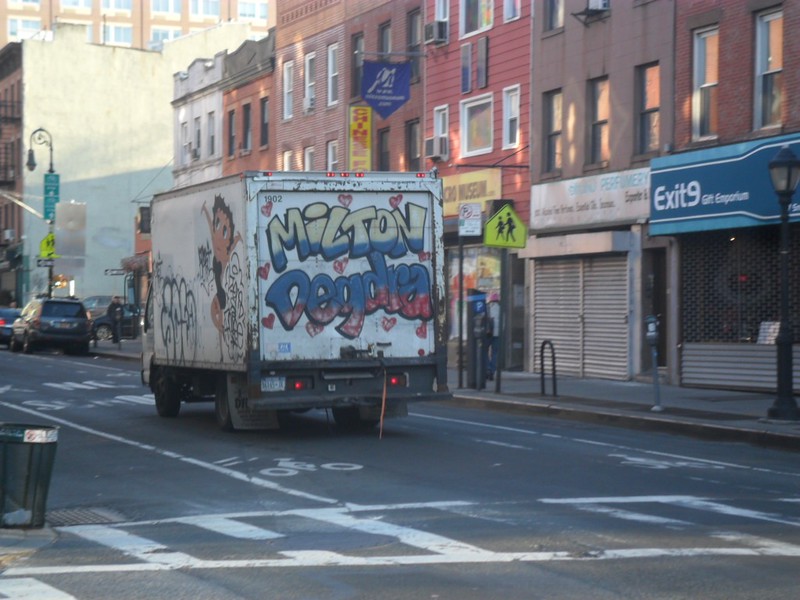
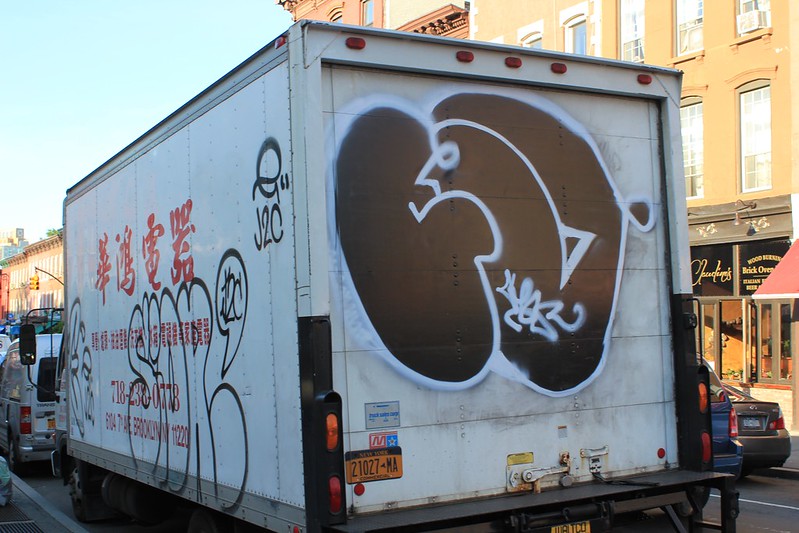
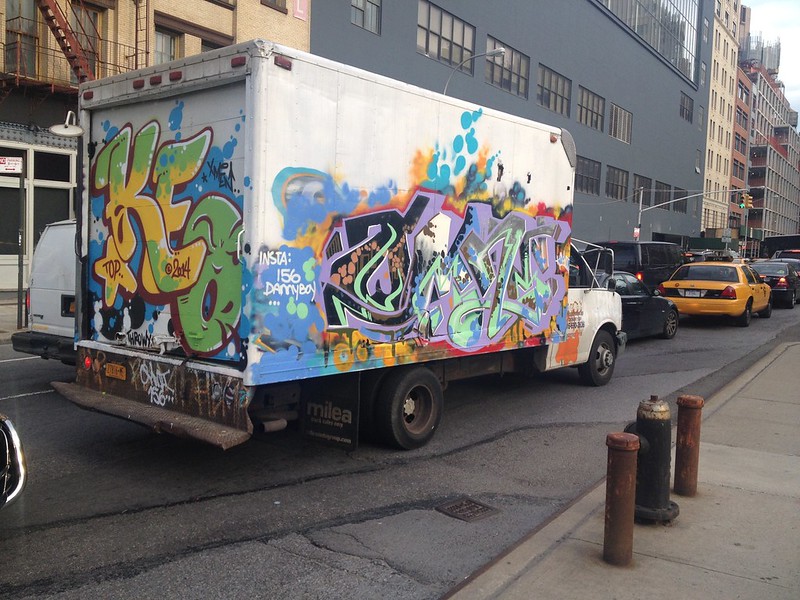
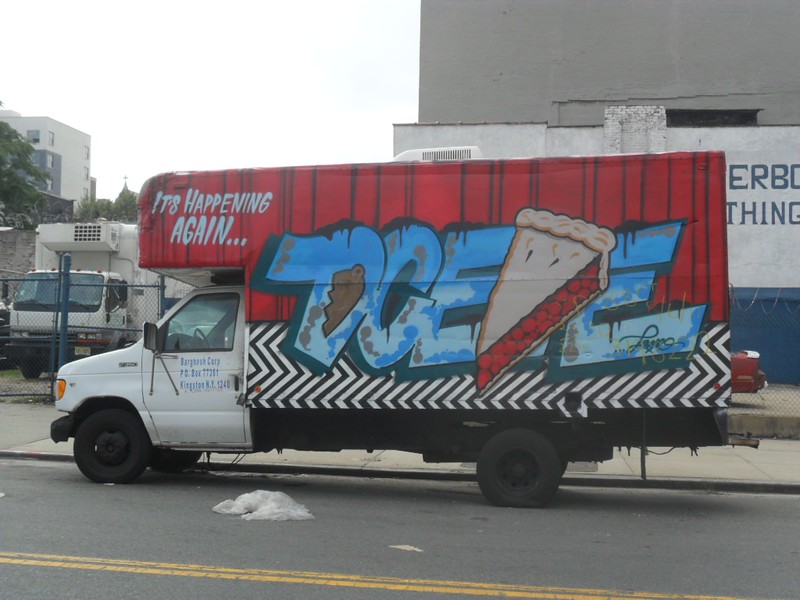
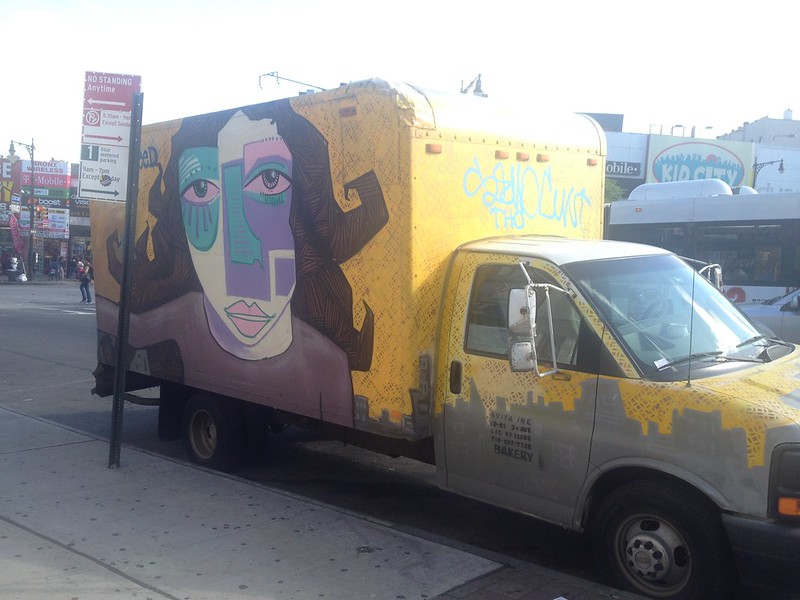
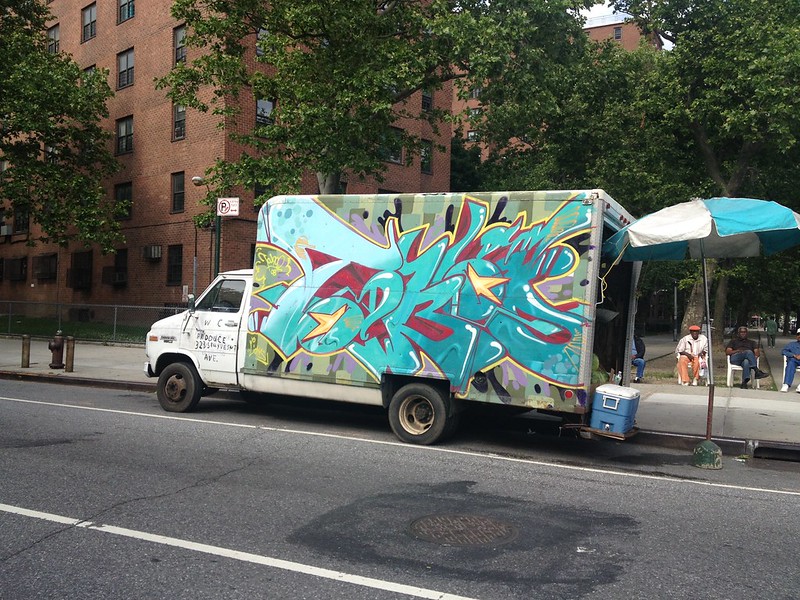
Not only does a map take away any sense of surprise, it also lays bare the one real downside of building-based murals: Lack of movement. Many of the the earliest graffiti masterpieces (I make no distinction between graffiti and street art) unmappable in the traditional sense, because they never actually stood still. They were on train cars, which meant you might be able to clue someone in to the existence of one by telling them what line it was running on, but that's it.

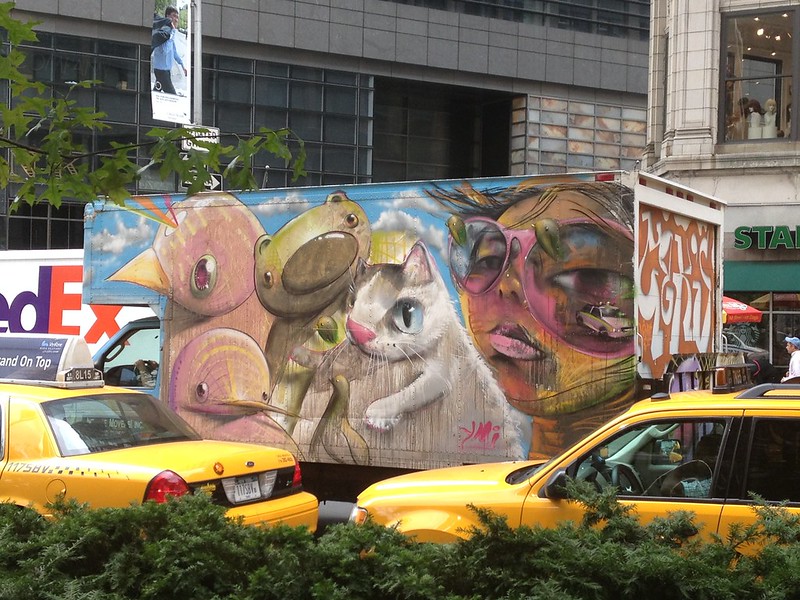
As we all know, the days of art-covered trains in NYC are long past. You might find a train that's been defaced by one of those dreadful car ads, but that's about it. Fortunately, we seem to be living in a renaissance of a different sort of movable art:

IMG_0747
I think what I like best about the box truck (and occasional moving van) phenomenon is it brings the art to me. I rarely find myself able to get out to Bushwick, Williamsburg or the Bronx, but I do work near Columbus Circle and Ninth Ave, where I saw this truck from Cernesto.

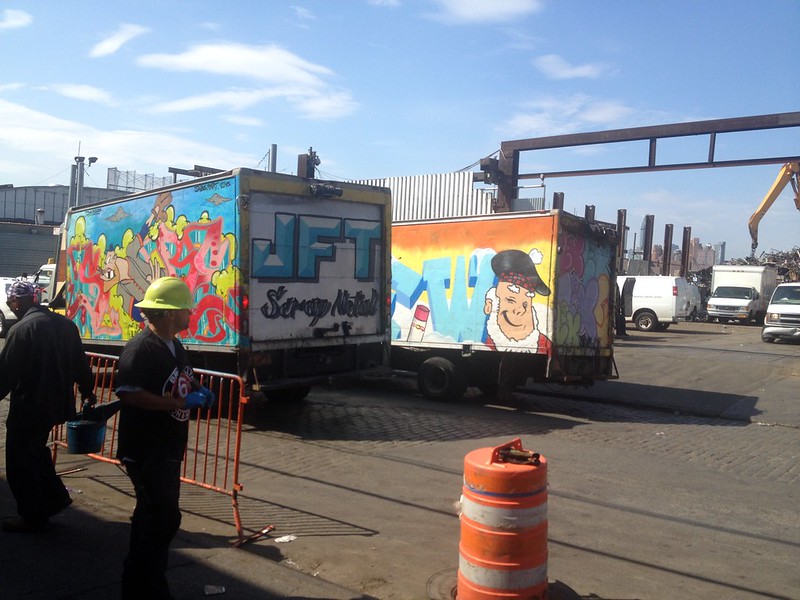
I also get down to Gowanus fairly regularly, where our local scrap metal recycling concern was host to not one but two trucks last month.
IMG_3174

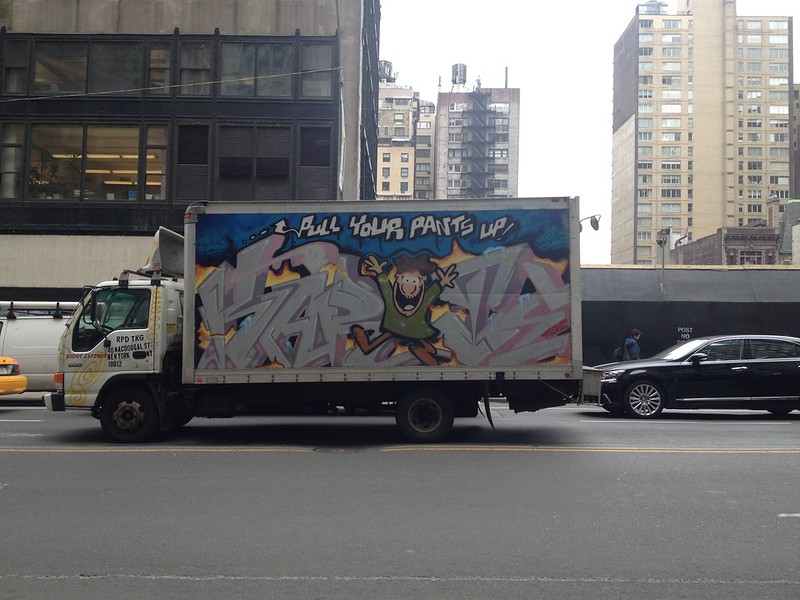
Beyond the occasional tag, you'll never find any decent graffiti on 57th Street, aka land of the billionaire's lairs. But keep your eye open on the traffic...
IMG_2713

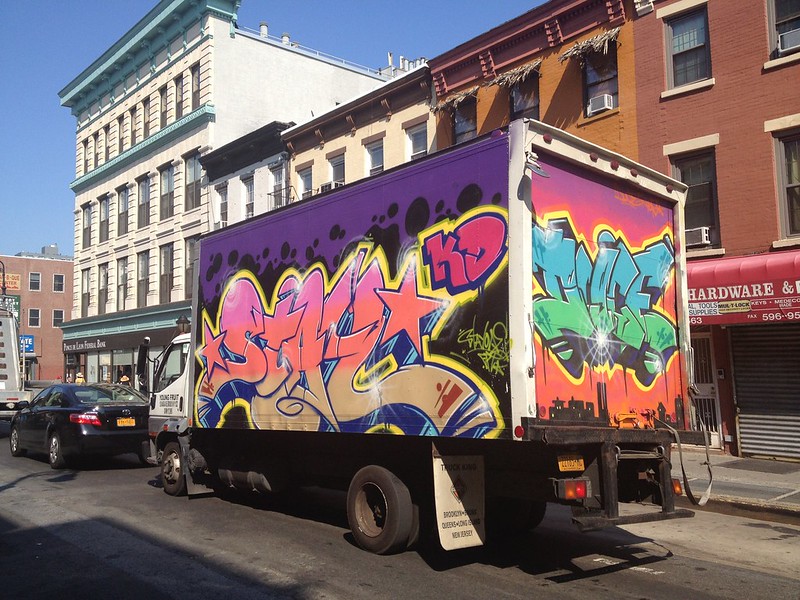
Some times I need only walk out the door onto Smith Street to catch a glimpse of something awesome.

IMG_0648

Now, graffiti is that unlike most art forms, in that its public nature dictates that the best of the best gets mixed in with crap, as there are no barriers to keeping out the latter. This is true of trucks too:

SAM_1054
Um, ok....

IMG_2436 Eh....

IMG_2999 Did we not finish this one? Note the reference to Instagram....
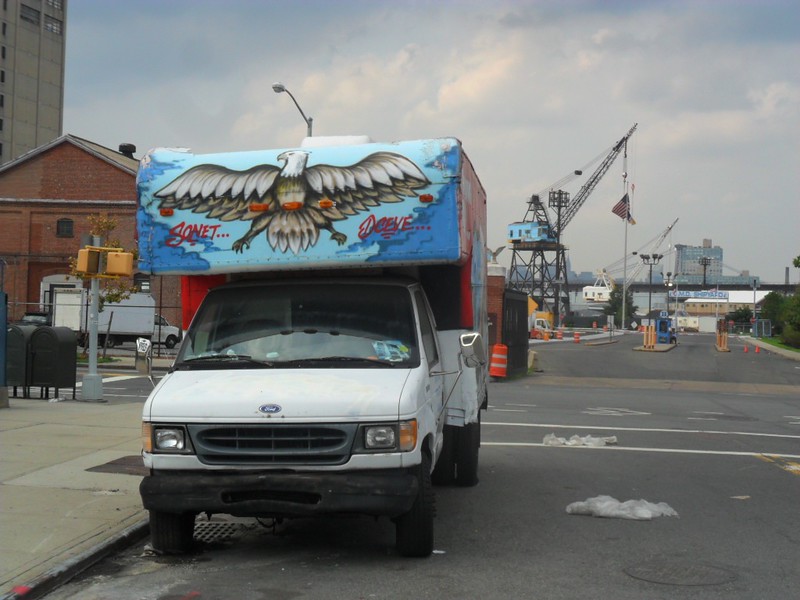
SAM_0823 But when they're done right, trucks with murals are like the perfect amalgamation of motion, pizzazz, and whimsy. This van, which was done by the Smart Crew, was parked in the shadow of the Navy Yard.

SAM_0824
'Merica!
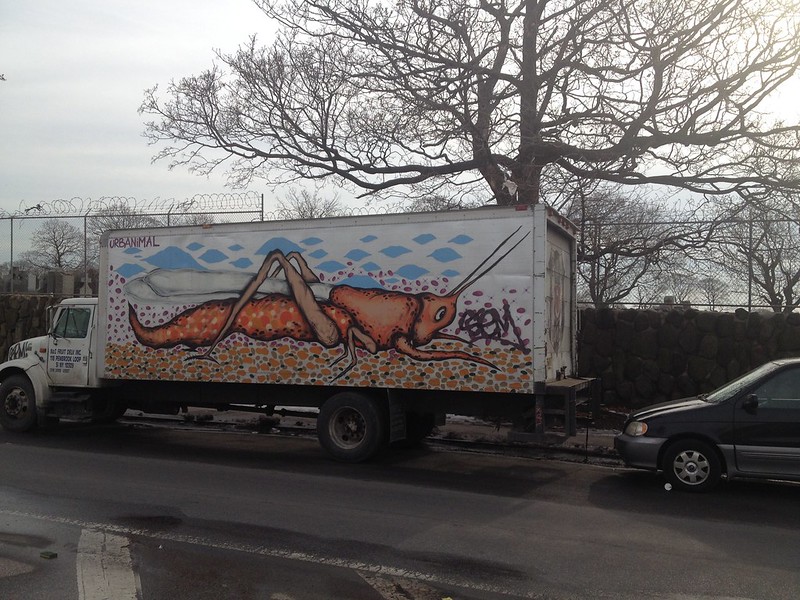
IMG_2401 Grasshopper, from Urban Animal, on Queens Boulevard. IMG_3028 Spotted this truck on Fordham Road.

I could go on and on here, but you get the general idea. Although the New York City's robust building mural scene is confined to a handful of neighborhoods, mostly in the outer boroughs, thanks to the equally bustling truck scene, graf is well-served to both well-heeled and down and out New York City hoods. Like food trucks, but with vittles for the creative soul..
IMG_1625

Fruit truck, Bed-Sty

Thursday, July 31, 2014

The eagle has landed

I don't think I can better sum up how I feel after this week than to simply share this picture from earlier this month. I have edited, re-edited, and edited yet again the manuscript. It has been reformatted to match the printing codes that the publisher uses, and the footnotes have been transformed into end notes. It has been printed out (103 pages) and burned onto a CD. 

Photos have been scrutinized for relevance and size, and if necessary, I have gone back to sites and retaken pictures and swapped out for new ones. They have been renamed to correspond with their respective chapters, and also both printed out and burned onto CDs. Meanwhile, an eight-page word document has been typed out with photo captions that not only instruct how to identify pictures, but also how big I'd like them to ideally be. XXX is the biggest. Heh...

Oh, that list has also been...yup, printed out and burned onto a CD. Add to these a survey describing what the book is all about, and the photo release forms I needed to get from folks nice enough to lend me their pictures (both on disc and printed), and you've got a nice little box ready to be FedExed first thing tomorrow.

Did I mention the marketing survey that I've only finished a quarter of? Christ on a cracker, books are hard work. Back soon, I promise...


Sunday, June 29, 2014

To be unexpected

Editing of text? Check.  Foot notes converted into end notes? You betcha. Academic jargon stripped? Well, sort of. There's still a lot left in the manuscript, and that's how I likes it. Gotta say more than just "Graffiti murals are cool, here's how some of them came to be," right? It's always painful to revisit words written a long time ago, even if that "ago" is less than five years; and indeed, some of what I wrote for my thesis, I can't even begin to wrap my head around. Needless to say, that was the easiest stuff to scrap.

Now I'm in the middle of a much less fun part: Pictures. Ugh. Along with a manuscript, I have to turn in a disc with all the images titled properly, along with a spreadsheet with corresponding captions, and if necessary, photo release forms. The rule for the latter is that if a picture was taken by me on private property, or if the picture belongs to someone else, then I need to get permission. If it was taken by me on public land, then it's mine to do with it what I please. Thankfully, roughly 75 percent of the images I want to use fall into the latter category. But I'm still going to have to wrastle up a few forms from folks.

Then there's the issue of photo quality. Some images aren't high res, and some, like this one, just aren't as good they should be (chain link fence in the front, shadows in the back). What can I say, I never really imagined I'd be considering this sort of issue when I embarked on the thesis four or so years ago.

So I'll be making a few trips to Inwood and possibly Staten Island in the next few weeks to snap a few more pics. I won't bore ya'll with the ins and outs of securing permission from folks to use their pictures or get proper captions; needless to say, I feel like I'm really close to being done. Formatting the text properly and making sure the new art goes where its supposed to is going to be very un-fun, but I've got a whole month left to make it happen.

Anyhoo! Saw this little guy earlier this month on a run through DUMBO:
If you've read much of my blog, you know I'm a sucker for figures in graffiti, and this has the added value of being somewhat cheeky and cute at the same time. And low and behold, Luna Park has written about him on her invaluable Street Spot blog. Apparently many pieces from Art is Trash are literally assembled out of trash, which makes them especially fleeting in nature. I like that notion; it's very much the way that New York City works. It can be jarring to see things come and go so quickly, especially when they're restaurants or stores that have been around forever (ahem, J&R, Pearl Art), but it's also what keeps things fresh.

But with all due respect, I'm not sure I agree that there's a need for an antidote for permission walls, at least not down this way. Mind you, I understand where her rationale from. A visitor to Williamsburg, Greenpoint or Bushwick these days can easily become overwhelmed by street art of all stripes; I know this because when I visit there, I hardly know where to look first. It's fair to say northern Brooklyn, the epicenter of NYC street art, is close to a saturation point. And this is coming from someone who likes this stuff.
Y'all sure ya didn't miss any spots there, eh?
It's an unfortunate reality of New York right now: Some places are filled to the rafters with street art, both sanctioned and unsanctioned, and others, like say, Sunset Park, are pretty much barren. Even down my way, Gowanus has a pretty sparse selection of inspiring graffiti. Sure, we get interesting entries here and there, like this, but rarely anything that makes you just go 'Whoah."

Well, until now. A few weeks, ago, I went for a run along Nevins Street, and stumbled on this, on the side of the Lower East Side Ecology Center's e-waste warehouse. Yes, I know the Lower East Side is in Manhattan. Haven't you heard everyone's moving to Brooklyn? I've dropped off various electronic gadgets here, and always thought this wall would be a great one for a mural; It's large, flat, blank and it's often tagged by random writers.

Apparently the good folks the Wallnuts thought so too. 
Werc Hernandez
I haven't been down to the wall since June 2; in that time the wall has had much, much more added to it. I can't wait to get back down there to see the finished product. I would imagine many people will be stopping and lingering awhile to see what is a bit of a rarity here, and which, for me, was as pleasant a surprise as the Art is Trash piece. Which just goes to show, as long as you don't overdo a good thing, it can retain the ability to amaze, impress and inspire.


Thursday, May 15, 2014

Cowabunga!

Ai yai yai, I just realized it's been exactly two months since I last posted. Sorry about that, Politics of Global Economic Relations really took a lot out of me. Great class, and I learned a lot about foreign direct investment, trade investment, and exchange rates, but it was definitely a steep learning curve. I basically never spoke in class, and instead just tried as hard as I could to sop up all the information flowing around me. Ask me about the World Trade Organization, the GATT and the Bretton Woods Agreement sometime!

So now it's time to buckle down and transform the thesis into a book. This is basically going to take all the summer, so I'll be referring to it here a lot, but I imagine I'll leave a lot on the cutting floor, lest I share too much that will end up in the book. I do want some people to buy it, you know?

In the mean time, I've been trying to keep at least one ear on the current street art situation in New York, which like the rest of the city is always changing fast. I've paid visits to Welling Court (with my daughter Eliza in tow) and the Bushwick Collective recently, though it's been much harder to visit anywhere in the Bronx, upper Manhattan or New Jersey.  Comes with living in Brooklyn, I guess.


A few articles that have caught my eye, either from the folks at Brooklyn Street Art, Street Art NYC, Luna Park, or Graffiti New York:

The New Must-Have for Luxury Buildings: Graffiti
Solid reporting, and super depressing at the same time. I've seen 40 Bond up close, and I think I've even taken pictures of the spaghetti-like scrim that lines the front. And while I actually think it's kind of a neat accoutrement, I never once mistook it to be related to graffiti. Fortunately, no one seems to really take seriously the developers' assertion that it represents a "downtown-on-the-edge point of view," whatever the fuck that means. In my business, we call that a word salad with a heaping side of bullshit.

I'm on this guy Niklas Maak's side:

“What they pioneered as a form of protest is transmuted into a fortification that prevents them from spraying onto the actual façade,” he says. 

I also find it amusing that the  word “NO” written in dark-orange spray paint, is somehow seen as "edgy" for a development in DUMBO, the single most expensive neighborhood in Brooklyn. How, exactly, is this any different from leaving the remains of a antique advertisement for Ma Bells' Miracle Cream? You're looking at a remnant, you dolts, nothing more. Talk to me when you live the way the folks do at 190 Bowery.
190 Bowery, a/k/a the coolest house in Manhattan
Final thought: I'd like to ask author Elizabeth Greenspan if she's ever left Manhattan. Because when I read "Meanwhile, the kind of graffiti for which New York is most famous—tags wallpapering subway cars and city walls—has largely disappeared," I laughed out loud. Yes, tags are gone from subways. But walls? Oh, honey, come on out to Brooklyn some time, and I'll show you OODLES of tags. You won't even have to go all the way to East New York, I promise!
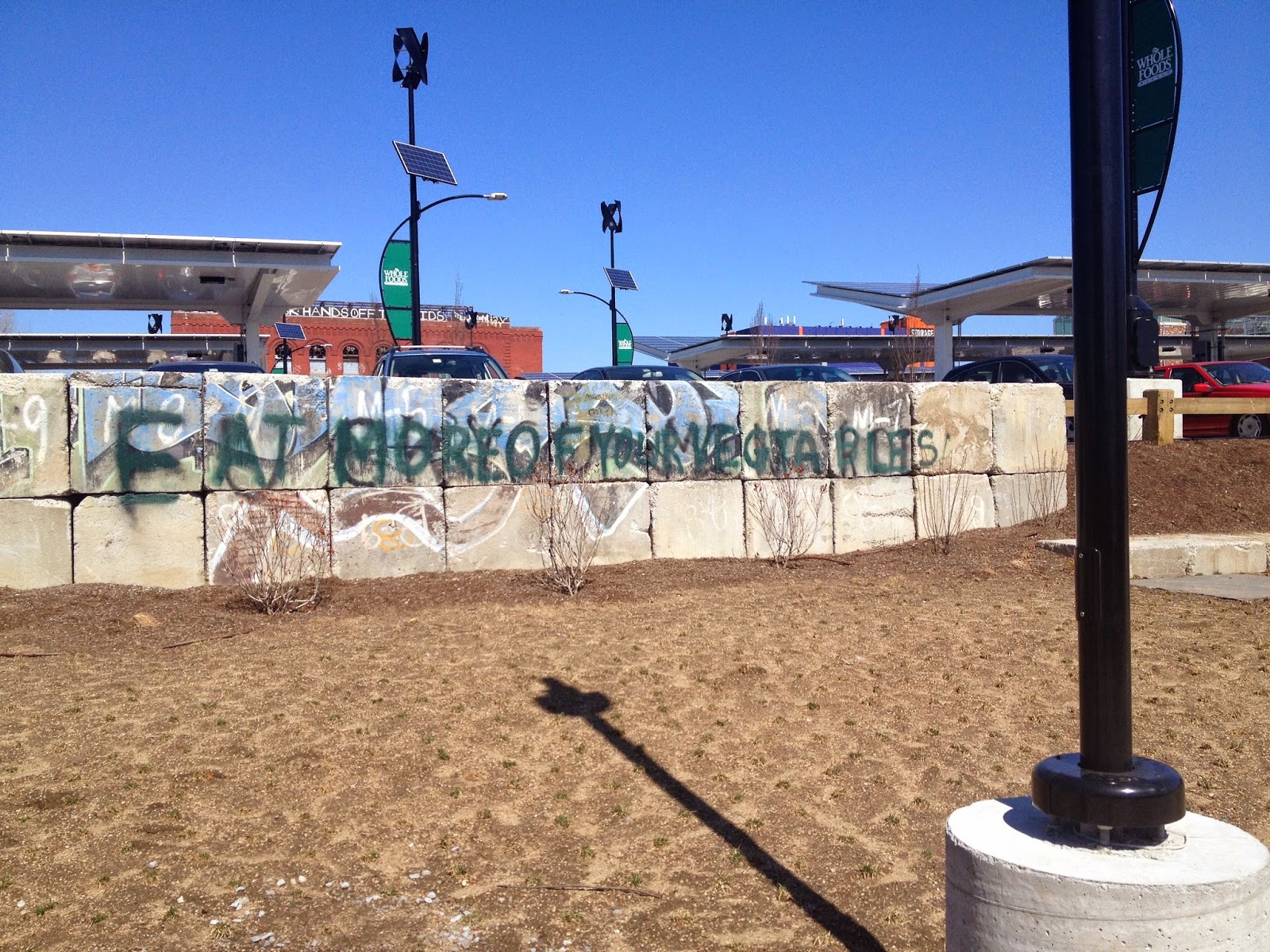
That's right they even have graffiti at Whole Foods in Gowanus.
Eat more of your vegetables!
But don't take my word for it. Even new NYPD honcho Bill Bratton agrees! I'm not sure how I feel about his assertion that graffiti is growing in NYC and "as a city, we need to basically take it on because that’s the first sign of urban decay.”

On the one hand, he's parroting the same old "Broken Windows" theory that law enforcement refuses to let go of, in spite of the fact that the theory has been proven to be wrong. I mean, Greenpoint, Williamsburg and Bushwick are dripping with graffiti these days, but do you hear anyone worrying about how these three neighborhoods are spiraling into hellish crime zones? Anyone? Bueller?

Tags? What tags? That stuff's gone yo!
The optimist in me hopes that this means a guy like Bratton might be open to exploring new ideas for combating vandalism, including murals. I mean, it's already being done on a large scale at the Bushwick Collective, and on smaller scales like this mural in the Bronx. Hell, even Amtrak is getting into the art game! The pessimist sees a guy who made his name in the 90's stamping out "Quality of Life" crimes in NYC, and like so many others, he may view the problem as one of enforcement, and nothing more.
Robots Will Kill's latest addition to Bushwick. I can see it now:
"You know, we really like the face, but can you do it more, "sideways"?
Fingers crossed!


Friday, March 14, 2014

It's go time

I can still see myself sitting in my first masters class, "Issues In Urban Studies," waaaaaaaaaaay back in the fall of 2009. What was my thesis going to be, I was asked. I had no clue, but just for the hell of it, I threw out "graffiti" as an answer. That's urban, I thought. Right?

Ok, fine, said my professor. What about it? Ah, yes, what about it indeed....

Almost five years later, here we are. New York City Graffiti Murals: Signs of Hope, Marks of Distinction is finished, and so far, it has been downloaded 106 times since it was uploaded in May. Perhaps just as encouraging, my 111-page opus is the first result when you Google "Patrick Verel." We're gaining some steam here, slowly but surely...

All this has taken place during a time of, shall we way, extreme busy-ness, as the class I'm currently taking, Politics of Global Economic Relations, demands I read roughly one full academic article a day, on subjects such as NAFTA, the IMF, and exchange rates. During my last class, we discussed the Gold Standard. Fun shit!

Ah, but this too shall pass, and come May, the fun begins anew. On Tuesday, I mailed a signed contract to Pennsylvania-based publisher Schiffer Books, which has accepted my proposal to turn the thesis into a book for popular consumption. Not too shabby for a project that was borne out of panic, eh?

So the next step is to craft a manuscript for a book that I can't quite envision at the moment. I do know that I'll make a strong case for the role that graffiti murals, when done with the right amount of coordination, can be a source for good both for the economy and community. Not only that, but I really do believe that they can stand as a bulwark against homogenization, which is just one of the many scourges of extreme gentrification.

I'll probably have to tone down some of the academic aspects of it (I'm looking at you "theoretical framework"), but there are still enough nuggets of info and anecdotes about the creative process to warrant a full book treatment. I can say without shame that my photographs aren't going to be mistaken for a coffee table book, but they'll definitely do the job. And in any case, there are LOTS of great collections of photography about graffiti out there already, so it would be foolish to try to compete with them.

So then the question becomes, who is this for? By agreeing to work with a popular publisher, and not an academic one, I worry that I may lose the kind of reader who would  gravitate toward things like David Harvey's concepts of "monopoly rent" and "marks of distinction." It may be that the case studies really draw the bulk of interest; if that's the case, that's great; those six vignettes form the scaffolding upon which the rest of structure is hung.

I mean, Nicer's musings on the place of graffiti in the greater art scene; Luv 1's commentary on the need to have more "human finger prints" spread around; Veng's comparing work with spray paint to that of paint brushes, and all the artists' rationales for embracing the ultimate sqaureness-working legally-who wouldn't want to read that?

And yet...if the case studies are the foreground; the flashy front that grabs your attention and lends the book a patina of hipness, then symbolic interactionism, the broken windows theory, and Walter Benjamin's "aura of art" are the background that give heft to the ultimate assessment of these murals. I know, I was just talking about scaffolds, and now I'm using background and foreground metaphors; I'm still searching for the right comparison. I guess the point is the two feel inseparable...

But, GOOD NEWS! I have until August to work these issues out, along with any knotty copyright issues that might arise with photography. Who knows, this might actually end up being pretty kickass and actually sell a few copies. I feel like I'm on a train with no clear destination, and all that matters is it's still moving. I have no idea where or when it may stop, but in the mean time, I'm trying to enjoy the ride.
Red Hook, Van Brundt Street